A German friend says "Ich rufe meine Mutter heute Abend …" and your brain stalls. Rufe means "call," so you start to relax, except the sentence isn't done. The verb isn't done. There's a word still coming at the very end, and until it lands you don't actually know what she's going to do. Call her? Call her up? Something else entirely? You wait. The pause stretches. By the time "an" finally drops, the rest of the sentence has already washed past you.
That freeze is the real problem with German separable verbs. Not the grammar. The grammar fits on an index card. The problem is that German tears a verb in half and throws the meaning-bearing half to the end of the sentence, and your ear, trained on English, isn't built to wait that long.
Here's the good news up front: you already do this in English. "Turn the light off." "Pick your sister up." The verb is turn off and pick up, but the little tail slides somewhere else in the sentence. German runs on the same instinct. It just throws the tail much further, all the way to the end, and that distance is what wrecks your listening.
What actually happens: a separable verb gets torn in half
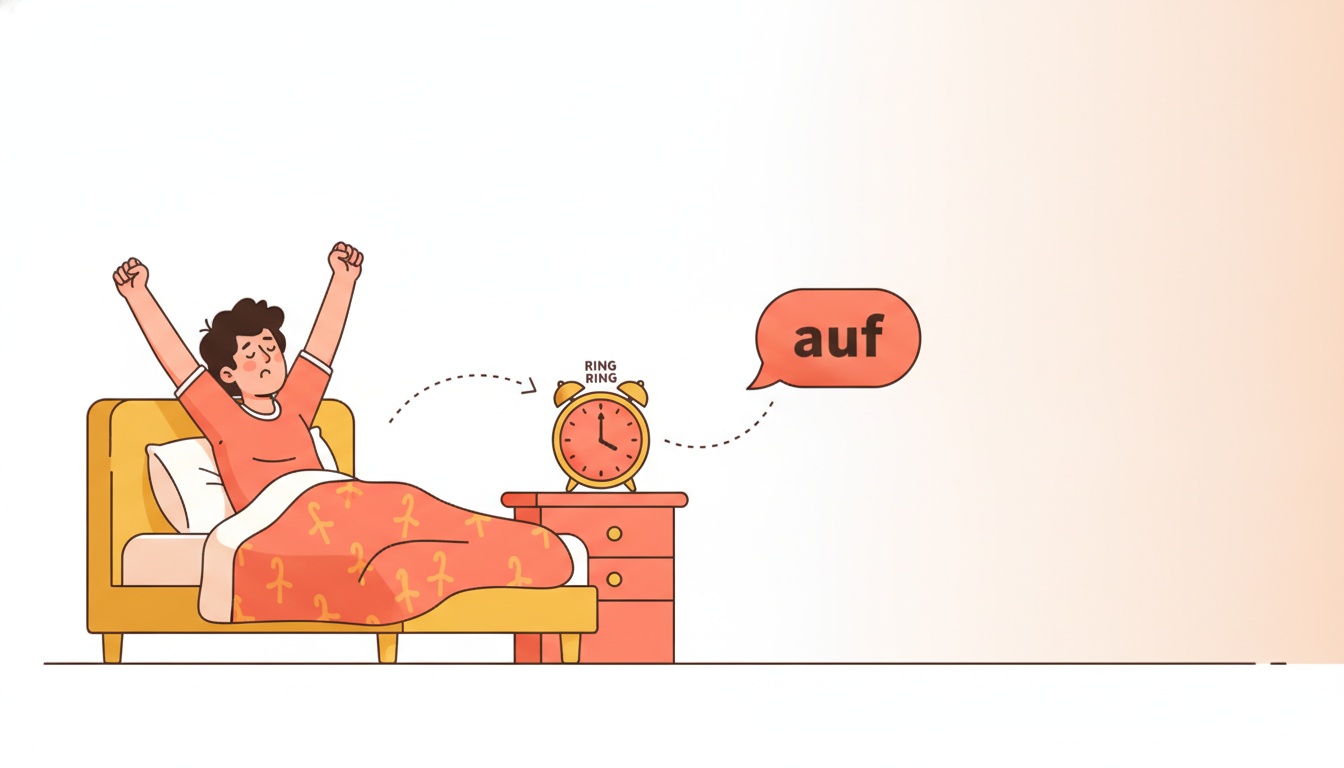
In the dictionary, the verb is aufstehen (to get up), one tidy word. In a real sentence it splits: "Ich stehe um sieben Uhr auf." The conjugated stem stehe takes its normal second-position spot, and the prefix auf flies to the end and waits there (Lingolia).
This happens with a big chunk of everyday verbs:
- anrufen (to call): "Ich rufe dich später an." (I'll call you later.)
- einkaufen (to shop): "Wir kaufen am Samstag ein." (We shop on Saturday.)
- fernsehen (to watch TV): "Abends sehen wir fern." (In the evenings we watch TV.)
- mitkommen (to come along): "Kommst du mit?" (Are you coming along?)
In every one, the part that tells you what's going on, an, ein, fern, mit, is the last thing out of the speaker's mouth.
Why this wrecks listening and not speaking
"Ich kaufe ein" feels easy to say, because you chose einkaufen before you opened your mouth. You already know how your own sentence ends. The trouble is one-directional: it only hits you when you listen.
Listening, the prefix is the last card turned over, and it can change the whole hand. "Ich rufe meine Mutter heute Abend …" could resolve into anrufen (call her), but a German stem like rufe could in principle head other directions before the prefix settles it. You can't lock in the meaning early. You have to hold it open.
English lets you off easier. We split verbs too, but the particle shows up in the middle of the sentence, not pinned to the back wall: "turn the light off" puts off four words in, not fourteen. German makes you wait longer. That longer wait is exactly where my own listening used to fall apart. The sentence keeps moving while you're still holding the door open for a prefix that hasn't arrived.
The ear-test: a stressed prefix is about to split
Say aufstehen out loud and the weight lands on the front: ÁUF-stehen. That stressed prefix is the sound of a verb that's going to split. Now say verstehen (to understand): the stress slides off the prefix and onto the stem, ver-STÉH-en. That unstressed prefix never leaves. "Ich verstehe das" keeps the verb whole; there's no stray ver waiting at the end (How to Study German). That's the tell most guides bury in a footnote: separable prefixes are stressed, inseparable ones aren't.
A handful of prefixes are permanently glued on and never split: be-, ge-, er-, ver-, zer-, ent-, emp-. They give you verstehen, bekommen (to receive), erklären (to explain), gefallen (to please), entscheiden (to decide), empfehlen (to recommend), zerbrechen (to shatter). None of them split, and as a bonus none of them take a ge- in the past participle: it's verstanden, never "geverstanden" (How to Study German).
To be clear about what this rule is: it's the pattern teachers point to, and it holds up remarkably well. But nobody has handed you a stopwatch-and-spectrogram proof that you'll catch the stress every time at conversational speed. Treat it as a strong bet, not a law of physics. Even so, training your ear to flag a stressed front syllable will do more for your listening than another prefix list ever will.
The strategy nobody teaches: wait for the prefix
Run it on this sentence: "Ich rufe meine Mutter heute Abend an." Your brain wants to resolve rufe immediately. Don't. Hold it open through "meine Mutter," through "heute Abend," and only at an do you close the loop: she's going to call her mother tonight. That deliberate wait feels unnatural at first, like leaving a sentence on read. With reps it turns into a reflex, and the reflex is the whole game.
So the actual skill is simple to state and annoying to practice: when you catch a stressed verb stem early, refuse to commit to a meaning until the last stressed word lands. This is a listening habit, not a grammar fact, which is why no amount of verb-table memorization installs it for you. You build it by hearing real sentences and catching yourself guessing too early. It's the same patience the German two-way prepositions ask of you, where whether a sentence means "into the kitchen" or "in the kitchen" only settles once you hear the whole thing. An AI conversation partner like Conversa is useful here precisely because you can let it talk and practice holding your interpretation open without a human waiting awkwardly for you to respond.
Try it in Conversa
Practice with AI characters who adapt to your level and give real-time feedback.
Try Conversa FreeWhere the two halves reunite
In the Perfekt (spoken past), anrufen comes back together as an-ge-rufen, the prefix snapped home with a ge- wedged into the seam. Same with ein-ge-kauft and auf-ge-standen. When you hear that little -ge- buried inside a word instead of sitting at its front, that's a separable verb announcing itself (Lingolia).
With a zu-infinitive, the zu slides into that same seam: anrufen becomes anzurufen, einkaufen becomes einzukaufen. "Vergiss nicht, sie anzurufen." (Don't forget to call her.) (Elon.io)
And in a subordinate clause, the whole verb travels to the end and rejoins there: "…, weil ich um sieben Uhr aufstehe." The prefix and stem sit back together because the entire conjugated verb has moved to the final slot.
The tricky ones: same spelling, two different verbs
"Er fährt den Pfosten um" and "Er umfährt die Baustelle" are built from the same verb, umfahren, and mean opposite things. Stress the front, ÚM-fahren, and it's to knock something over (the post goes down). Stress the stem, um-FÁH-ren, and it's to drive around (you avoid the construction site). Same letters, opposite actions, and your only clue in the moment is which syllable got the weight (VerbPal). In real life you'll meet the "drive around" sense far more often than the "knock over" one, so don't lose sleep over it.
A few other prefixes (über-, durch-, unter-, wieder-) play the same trick. übersetzen is ÜBER-setzen (separable) for ferrying someone across a river, and über-SÉTZ-en (inseparable) for translating a text. Don't try to memorize the full set now. Just know they exist, and that when one ambushes you, the stress is still doing the same job it always does.
What to actually do with this
The fix for the mid-sentence freeze isn't another prefix chart. You already understand the rule. What you're missing is the ear for it and the patience to wait. Next time a German sentence stalls your brain and you feel yourself reaching for the meaning too soon, notice that you're waiting for a prefix, and let it land. That pause you hate isn't you failing to keep up. It's you finally listening to German the way it's actually built. The same wait-and-train approach that rescues your Spanish listening works here too: more real input, less early guessing.