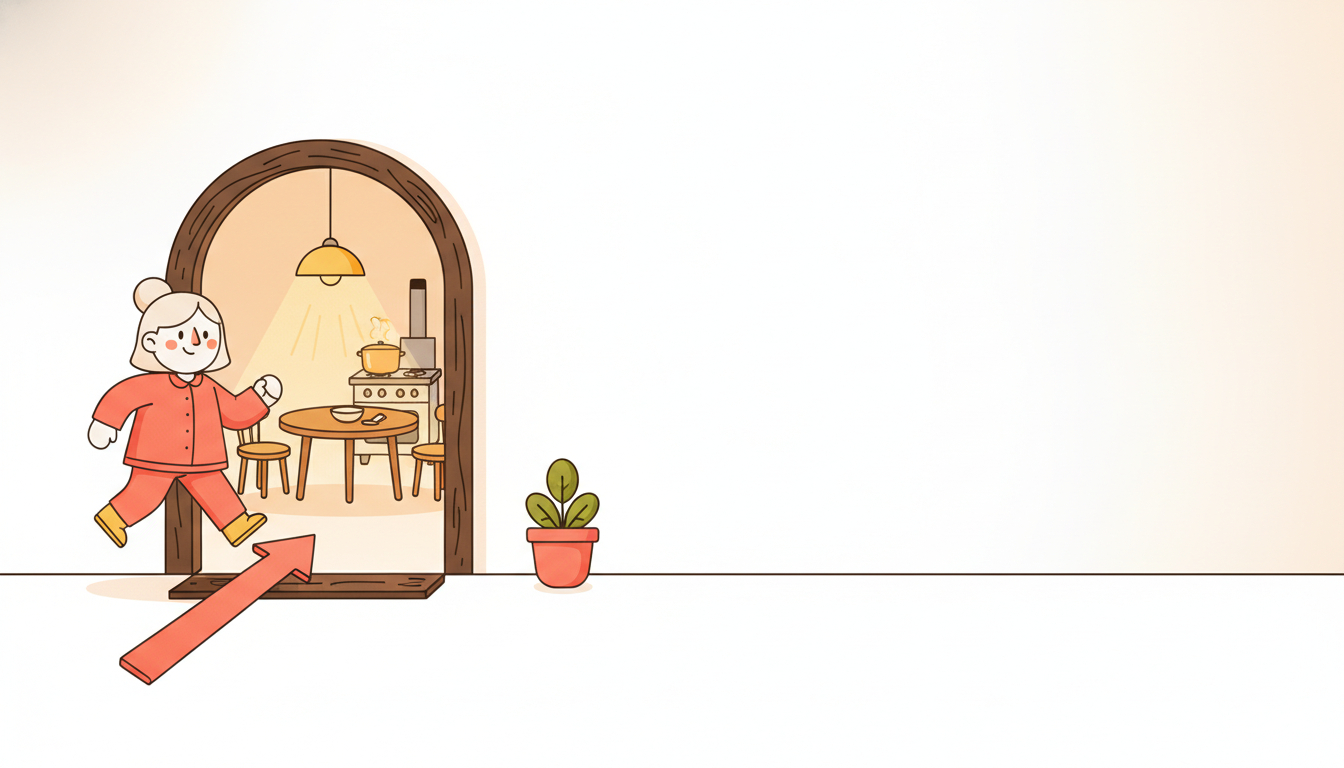
"Ich gehe in die Küche" means I'm going into the kitchen. "Ich bin in der Küche" means I'm in the kitchen. Same preposition, in, but the article flips from die to der, and that flip is the whole ballgame. This is the exact spot where a confident German beginner stalls mid-sentence: which one is it, die or der?
This is the German two-way preposition problem in miniature, and you were probably handed a rule to fix it: movement takes accusative, no movement takes dative. It's a tidy rule. It's also the thing that's breaking you, because it falls apart the first time you say "I'm running in the park." Here's the rule that actually holds.
The nine German two-way prepositions that play both sides
Most German prepositions pick a side and stay there. Durch (through) is always accusative. Mit (with) is always dative. You learn it once and you're done. But nine of them refuse to commit: in, an, auf, über, unter, vor, hinter, neben, zwischen. Grammar books call them Wechselpräpositionen, the "switching" prepositions, and they take accusative or dative depending on how you use them (Wikibooks German grammar).
These are the nine that make you hesitate. Learn what triggers the switch and you've cleared the single biggest hurdle in German prepositions.
Why "movement equals accusative" is the wrong rule
The movement rule feels right because it works often enough to fool you. "Ich gehe in die Küche" has obvious motion and takes accusative. So your brain files away: motion equals die, equals accusative. Then you try to say you jog in the park, jogging is clearly motion, and a native speaker corrects you to dative. Now you don't trust yourself anywhere.
Throw the movement rule out. The real question is whether the noun is a destination or a location. Accusative marks a destination: a place you're crossing into, a boundary you're putting something past. Dative marks a location: the setting the whole scene already sits inside.
Look at the kitchen again with that lens. "Ich gehe in die Küche" (accusative) makes the kitchen a destination, the place I'm headed, the threshold I'm about to cross. "Ich bin in der Küche" (dative) makes the kitchen a location, the room I'm already standing in. Nothing about speed or motion decides it. Only whether the kitchen is where I'm going or where I am.
The two-second test: wohin or wo?
You don't have to feel your way through "destination versus location" every time. Ask the sentence a question. If it answers wohin? (where to?), it's a destination, so accusative. If it answers wo? (where?), it's a location, so dative (Your Daily German).
Run it on a picture going up on a wall. "Ich hänge das Bild an die Wand." Where am I hanging it to? An die Wand. That's wohin, so accusative, die Wand. Now the picture is already up: "Das Bild hängt an der Wand." Where does it hang? An der Wand. That's wo, so dative, der Wand.
One more, because the test never breaks. "Die Katze springt auf das Bett." Wohin does the cat jump? Onto the bed. Accusative. "Die Katze schläft auf dem Bett." Wo does the cat sleep? On the bed. Dative. Two seconds, one question, every time.
The sentence that kills the movement rule: Ich laufe im Park
"Ich laufe im Park." I run in the park. Im is the dative contraction of in dem, so this is dative, even though running is about as much motion as a verb can carry. This is the sentence that wrecks the movement rule and confirms the real one.
Why dative? Because the park isn't your destination. You're not crossing into it, you're circling around inside it. The park is the location the whole run takes place in. Ask the test: wo laufe ich? Im Park. Where, not where to. Dative.
Now watch it flip with the same verb. "Ich laufe in den Park." That's accusative, den Park, and it means I run into the park from outside it. The park became my destination. Both sentences have a person running at full speed. The motion is identical. The only thing that changed is whether the park is the place I'm heading toward or the place I'm already moving around in. That is the entire system in one minimal pair, and it's why "is something moving?" was always the wrong question.
The verb that answers before you reach the preposition
"Ich stelle die Lampe neben das Bett" (I put the lamp next to the bed) is accusative. "Die Lampe steht neben dem Bett" (the lamp stands next to the bed) is dative. The verb changed from stellen to stehen, and that swap told you the case before you ever reached neben. German hands you this tell early in the sentence, and you can lean on it.
The placement verbs take accusative, because someone is putting something somewhere: stellen (to stand something up), legen (to lay something down), setzen (to set something), hängen (to hang something), stecken (to stick something in). The position verbs take dative, because something already rests there: stehen (to stand), liegen (to lie), sitzen (to sit), hängen (to be hanging), stecken (to be stuck) (CORE Languages).
You can hear the pairing. "Ich lege das Buch auf den Tisch" (I lay the book on the table, accusative, because I'm placing it there) versus "Das Buch liegt auf dem Tisch" (the book lies on the table, dative, because that's where it rests). The action verb means a destination is coming. The state verb means a location is coming.
Hängen is the sneaky one: the same spelling does both jobs. "Ich hänge das Bild an die Wand" (I hang it, accusative) and "Das Bild hängt an der Wand" (it hangs, dative) look nearly identical. Don't let the verb fool you here. Let the article do the talking, and run the wo/wohin test if you're unsure.
Try it in Conversa
Practice with AI characters who adapt to your level and give real-time feedback.
Try Conversa FreeThe contractions natives never spell out
German fuses these prepositions with their articles, and the fused form quietly carries the case for you. In das becomes ins. In dem becomes im. An das becomes ans, an dem becomes am. Auf das becomes aufs. You'll also meet vors, vorm, hinterm, unters, and unterm (FluentU).
The useful part: the contraction tells your ear the case before the rest of the sentence does. "Ich gehe ins Haus" can only be accusative, a destination, going into the house. "Ich bin im Haus" can only be dative, a location, already inside. Once you train your ear to hear ins as "heading in" and im as "already there," half of these sentences decode themselves before you've finished hearing them. This is one of the rare corners of German where the language is doing you a favor.
If you want this to become automatic, you need reps where the answer matters in real time, not another table to stare at. Saying it out loud with someone who corrects you on the spot is what burns in the die-versus-der reflex. An AI conversation partner like Conversa is a low-stakes way to get those reps without freezing up in front of a native speaker.
Try it on three sentences
Run the wo/wohin test on these before you read the answers. "Ich stelle die Flasche ___ den Tisch" (I put the bottle on the table). "Das Glas steht ___ dem Tisch" (the glass stands on the table). "Wir fahren ___ die Stadt" (we drive into the city).
First one: wohin do I put the bottle? Onto the table, a destination, accusative, auf den Tisch. Second: wo does the glass stand? On the table, a location, dative, auf dem Tisch. Third: wohin do we drive? Into the city, a destination, accusative, in die Stadt.
None of those depended on how fast anything was moving. The next time you freeze between der and die after one of these nine prepositions, don't ask yourself whether something is moving. Ask wohin or wo. That one swap is the fix, and once you trust it, the prepositions that used to feel like a coin flip stop feeling like one. If the case endings themselves still trip you, the same destination-versus-location thinking carries straight into the full accusative and dative system.