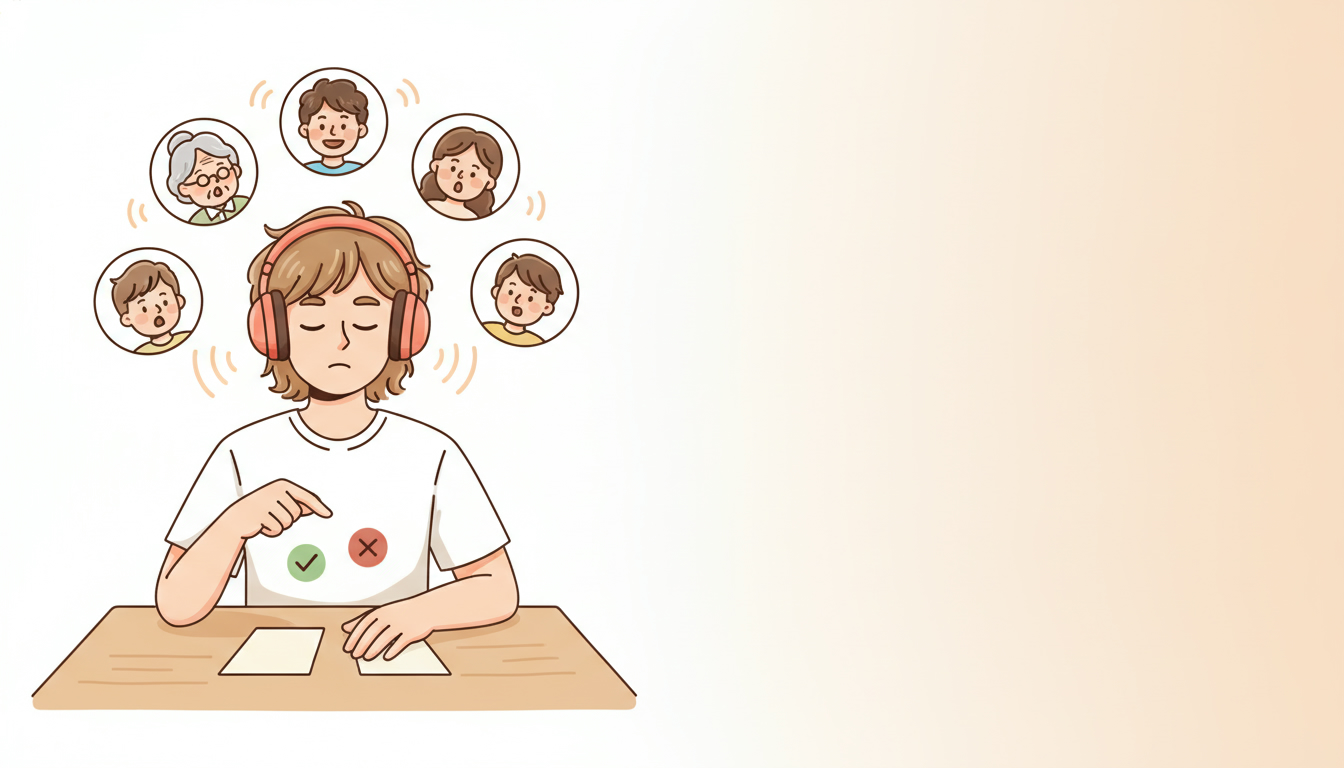
In 2002, forty Japanese adults living near Pittsburgh sat at computers and heard two words: rock and lock. After each one, they pressed a button for the word they thought they'd heard.
One group worked on a hard-to-tell version of the pair and never found out whether they were right. They got nowhere: no better than people who did no training at all. Another group did exactly the same thing, except a row of green checks or red X's flashed up after every guess. Three sessions of about twenty minutes, and they could hear the difference.
If one sound in your new language keeps coming out wrong, your mouth may not be where the problem starts. Ship comes out as sheep. 커피 (coffee) comes out as 코피 (nosebleed).
Years of practice haven't moved it. Most of the time you can't hear the difference between the two sounds yet, and you can't aim at a target you can't hear.
Below: a two-minute test that tells you whether your problem is your ear or your mouth, what 79 studies say about retraining an adult ear, how to run the training, and the catch most ear-training pitches skip. Hearing it right only gets your mouth part of the way.
Why two different sounds sound identical to you
Japanese has one sound where English has two: a quick tap of the tongue that sits between R and L. So right and light, /raɪt/ and /laɪt/, land in the same bin. Spanish has one "ee" vowel where English has two, which is why ship and sheep, and hit and heat, blur together for so many Spanish speakers.
Your first language spent your childhood teaching you which sound differences matter and which to ignore. It did a good job. When a new language puts two sounds where yours has one, your ear does what it was trained to do and files both under the same label.
English speakers get this in reverse. Korean splits what English ears hear as one vowel, somewhere between "uh" and "oh," into ㅓ and ㅗ. The stakes are a hot drink:
코피 (kopi) is a nosebleed. 커피 (keopi), with flat, unrounded lips, is coffee.
French does it with the vowels in dessus and dessous, which mean opposite things:
Both vowels have rounded lips. The tongue sits forward for u and back for ou.
Two words that differ by one sound are a minimal pair, and they are the raw material for everything below. Each of these contrasts has its own guide here: English R and L for Japanese speakers, ship and sheep for Spanish speakers, 커피 and 코피 for English speakers, and French u and ou. This post is about the method under all of them.
Is it your ear or your mouth? A two-minute test
Get recordings of your problem pair from a voice you have never practiced with. Forvo is free to browse and often has several native speakers recording the same word.
Ask a friend to play the two words in random order, twenty times, while you keep your eyes shut and name each one. Have them tell you the right answer after every guess.
Close to perfect means your ear is fine, and you can skip to the section on speaking. Near 50% means you are guessing. Anything in between means your ear catches the contrast sometimes, usually from the voice you already know. My rule of thumb is about 18 out of 20 from a stranger's voice before you call the ear done. That number is mine, not a study's.
Naming which word you heard is called identification. In the 2025 meta-analysis covered in the next section, identification training worked far better than "same or different?" listening. With the answer after each guess, the test doubles as the training.
Can adults learn to hear new sounds? 79 studies say yes
The method has a clumsy name: high variability phonetic training, or HVPT. You hear minimal pairs from many different voices, say which word it was, and find out immediately if you were right. In 2025, Takumi Uchihara, Michael Karas and Ron Thomson pooled 79 HVPT studies from about thirty years of research.
On the words they trained with, learners' accuracy rose by about 14 percentage points. On brand-new words spoken by brand-new voices, it rose by about 13. People in untrained comparison groups, who just took the test twice, gained 2.7. The new ear works on words you never practiced, only slightly less well.
It also lasts. Thirty of the studies retested people later, on average 2.3 months on and in some cases six, and the gains had held. Lower-level learners slipped a little.
The classic version is Ann Bradlow's 1997 study. Eleven Japanese adults trained their ears on R and L for three to four weeks and went from 65% to 81% correct.
Three months later, the nine who came back were still at 78%. These were adults. Whatever window you think closed when you were twelve, it was still open for them.
Why listening more doesn't fix it on its own
Back in Pittsburgh, the group that worked through the hard version of rock and lock more than a thousand times with no answer key ended up where the untrained group did. Bruce McCandliss and colleagues also ran a group without feedback that started on exaggerated versions, easy to tell apart, with the gap narrowed bit by bit. They learned, though more slowly. With a check or an X after each answer, both versions worked, and the gains carried over to a second pair, road and load.
That's why five years of podcasts haven't fixed your ship. A podcast is the hard version with no answer key. If your ear files the two vowels as one, every episode confirms the wrong filing, and context fills the gap so smoothly you never notice the miss.
Feedback is what breaks the loop most reliably: being told, every time, which word it was. Starting easy helps too. The study used computer-stretched sounds, and the closest everyday version is the slowest, most careful speakers you can find, with fast, casual speech saved for once those feel obvious.
Why many voices beat one, and when to start with one
In a 1993 study by Scott Lively, John Logan and David Pisoni, Japanese learners trained on R and L with several talkers improved and carried that to new words and to an unfamiliar voice. A second group trained with one talker. They improved during training, then failed to transfer it to a new talker.
One voice teaches you that voice. Your ear learns where that one speaker puts the sound, and the first stranger who says light a little differently breaks it. The HVPT studies averaged about five voices, anywhere from two to thirty, and more voices helped the stronger listeners most.
Two honest caveats. A 2017 study of Greek speakers learning the ship and sheep vowels found no benefit from four talkers over one, though most of that result came from eight-year-olds; the adults leaned slightly, not significantly, toward four.
The second caveat is more useful. In Tyler Perrachione's 2011 tone-learning study, learners who started with a weak ear for pitch did worse when the voice switched on every trial. Grouping the voices into blocks, one speaker at a time, rescued them.
So if a shuffled mix of voices feels like static, start with blocks: one voice for ten words, then the next voice. Shuffle once the blocks feel easy.
How to run an ear-training session
The typical study in the 2025 meta-analysis ran about nine sessions of 36 minutes. That's roughly five hours in total, and gains kept rising up to about 6.7 hours before they leveled off. A few weeks of evenings.
Pick one contrast. Kazuya Saito and Luke Plonsky's review of 77 pronunciation studies found instruction worked best when it zeroed in on specific sounds, so 어 versus 오 for a month beats "my accent" forever.
Gather recordings of both words from four to six speakers. Play one, decide which word it was, check, repeat. Label your answers with the written words: in the HVPT meta-analysis, picture labels did about half as well.
For English sounds, English Accent Coach does exactly this. You hear a word, click the sound you heard, and it scores you. Ron Thomson, one of the meta-analysis authors, built it, so weigh that. It covers English only.
For any other language, build your own. Download clips of your pair from several Forvo speakers, put them in Anki or any flashcard app with the audio on the front and the written word on the back, and shuffle. The back of the card is your answer key.
I can hear the difference but still can't say it
Uchihara, Karas and Thomson asked the obvious follow-up in 2024: does ear training fix your mouth? Across 31 studies, pronunciation improved by about 10.5 percentage points on the words people had trained their ears on. On words they hadn't trained, it moved about 4.5, too little to be sure it was real. That speaking gain also faded more over the following six weeks or so.
It doesn't track person by person, either. In Bradlow's group, one trainee's hearing improved by about 6 points and their pronunciation by 16. Another's hearing jumped 25 points while their pronunciation moved 4.
So the title of this post is half true. You can't reliably say a sound you can't hear. Hearing it doesn't mean you can say it.
Give your ear a head start, though. One lab, Melissa Baese-Berk and Arthur Samuel's, found that saying new sounds aloud while people were still learning to hear them made the hearing worse. A 2026 review calls the evidence on this mixed, so treat it as a reason for a session or two of listening first, not a rule.
The other half is saying the word out loud and finding out right away whether it landed. In Ngo, Chen and Lai's 2024 meta-analysis of speech-recognition pronunciation tools, explicit feedback, being told plainly which sound was off, was worth nearly twice as much as a vague nudge. The same analysis found that under five weeks of practice, the benefit was close to nothing. From five weeks on, it was large. If you're in week three and nothing has changed, that's what week three looks like.
This is the half Conversa covers. It's an AI conversation partner you talk to out loud, and after each turn it marks each word Clear, Close or Revisit; tap a word to hear yourself and then the model. It doesn't run ear training, so do that in your flashcards first.
Try it in Conversa
Practice with AI characters who adapt to your level and give real-time feedback.
Try Conversa FreeOne pair, two halves
Pick the single pair that embarrasses you most. 커피 and 코피 count. Spend about five hours, spread over a few weeks, naming which word you heard from half a dozen strangers, with the answer on the back of every card.
Then say it out loud, in sentences, to something that tells you whether it landed, and give that five weeks before you judge it. In the studies, the ear held for months and the mouth slipped sooner, so keep the word in your sentences after the drilling stops.