The character 妈 (mā, mother) is made of two pieces you can already point to: 女 on the left, 马 on the right. The 女 means woman. The 马 is a horse, and it's pronounced mǎ. Put them together and you get a character that means "mother" and sounds like "ma." One half tells you the meaning. The other half tells you the sound. Those two building blocks are called radicals, and they're the blueprint for most Chinese characters.
If you've been staring at 好, 河, and 妈 like they're random tangles of strokes to burn into memory one by one, this is the reframe that saves you. Characters aren't pictures you memorize. They're built from a small set of reused parts, and once you know the parts, you can decode characters you've never seen before. This post is about those parts and how to actually read them.
What a radical actually is (and the part nobody teaches)
Look at 妈 again. The 女 (woman) on the left is the semantic radical: it tells you what zone of meaning the character lives in. Anything with 女 tends to involve women, family, or relationships. The 马 on the right is the phonetic component: it's there for the sound, not the meaning. A horse has nothing to do with mothers. It's just that 马 is pronounced mǎ, so it lends its sound to 妈 (mā).
This two-part structure has a name: phono-semantic compounds (形声字, xíngshēng zì). And they aren't a niche category. They're the large majority of all Chinese characters. The figure you'll see everywhere is around 80%, though careful corpus work by Outlier Linguistics puts the count of characters with a functioning sound component closer to 74–77%. Either way, the takeaway is the same: most characters are built from a meaning part plus a sound part. Hacking Chinese calls the phonetic component "the key to 80% of all Chinese characters," and that's not marketing.
A quick vocabulary note so the rest of this makes sense. Strictly, a "radical" (部首, bùshǒu) is the component a dictionary files a character under, its section head. In casual use, people say "radical" for any recurring building block. You'll see both here. The traditional system has 214 of these radicals, the Kangxi set from 1716. Mainland China's modern simplified standard trimmed it to 201. You do not need all of them. You need about twenty to start, which we'll get to.
Decode a character you've never seen: a five-step teardown
Take 清 (qīng, clear). Pretend you've never met it. Here's the procedure.
Split it into components: 氵 on the left, 青 on the right. The left piece, 氵, is the "three drops of water" radical, a squished form of 水 (shuǐ, water). So the meaning is water-related. The right piece, 青, is pronounced qīng, so the whole character probably sounds like "qing." Combine the two guesses: water plus a qīng sound gives you 清, "clear" as in clear water, clean. Then confirm it in a dictionary if you're not sure.
That's the entire move. Split the character, read the semantic side for the meaning zone, read the phonetic side for the sound, combine, verify. You won't always nail it exactly, but you'll be close enough to remember it, and close enough to guess. That's the difference between reading a system and memorizing noise.
The sound side: guess the pronunciation from the phonetic
Once you notice that 青 (qīng) carries a sound, you start seeing it everywhere, and it keeps its promise. 请 (qǐng, please), 清 (qīng, clear), 情 (qíng, feeling), 晴 (qíng, sunny). Four different characters, four different meanings, one shared phonetic, and every one of them lands on some tone of "qing." The semantic radical changes each time (speech, water, heart, sun) but the sound rides along with 青. Just know the phonetic points you at the syllable, not the tone, and Mandarin's pinyin spellings hide their own traps: the q in qīng is nothing like the English q.
Now the honest part, because pretending the system is perfect would just set you up to distrust it. Two members of the same family break the pattern: 睛 (jīng, as in 眼睛 yǎnjing, eye) and 精 (jīng, essence) shifted from qīng to jīng. So the phonetic predicts the sound. It doesn't guarantee it. Hacking Chinese puts it plainly: you guess, you get close, you refine. That's still enormously faster than treating every character as a blank slate.
Here's a second family that behaves beautifully. The phonetic 包 (bāo, to wrap) gives you 抱 (bào, hug), 泡 (pào, bubble), 跑 (pǎo, run), and 饱 (bǎo, full). The sounds cluster around "bao/pao," and the radical out front tells you the rest: hand for hugging, water for bubbles, foot for running, food for being full.
Position tells you which part is which
In 妈, 清, and 请, the meaning part sits on the left and the sound part sits on the right. That's the most common layout by far: left is usually the semantic radical, right is usually the phonetic. The water drops 氵, the person radical 亻, the hand radical 扌, and the speech radical 讠 almost always show up on the left, doing meaning duty.
The other positions have their own tendencies. A radical across the top is usually semantic (艹 grass over 花 huā flower). So is one along the bottom (灬 fire under 热 rè hot). And 辶, the "walk" radical, wraps around the bottom-left corner in words about movement, like 这 (zhè, this) and 过 (guò, to pass).
The cleanest way to feel this is a minimal pair. Keep the phonetic 马 fixed and swap the radical: 妈 (mā, mother) with the woman radical, 骂 (mà, to scold) with two mouths on top, 吗 (ma, the question particle) with one mouth. Same sound-giver, three meanings, and the radical is the thing doing the steering.
Same radical, new disguise: the shapeshifters
The reason radicals feel hard at first is that many of them wear a costume. 水 (water) shrinks into 氵 when it moves to the left of a character. It's still water, just compressed into three drops. Miss that and you'll think 河 (hé, river) and 洗 (xǐ, wash) have nothing to do with 水, when they're both soaking wet.
The common shapeshifters are worth memorizing as pairs:
- 人 (person) → 亻 in 你 (nǐ, you), 他 (tā, he)
- 手 (hand) → 扌 in 打 (dǎ, hit), 找 (zhǎo, look for)
- 心 (heart) → 忄 in 忙 (máng, busy), 怕 (pà, afraid)
- 言 (speech) → 讠 in 说 (shuō, speak), 语 (yǔ, language)
- 金 (metal) → 钅 in 钱 (qián, money), 银 (yín, silver)
- 艸 (grass) → 艹 in 茶 (chá, tea), 菜 (cài, vegetable)
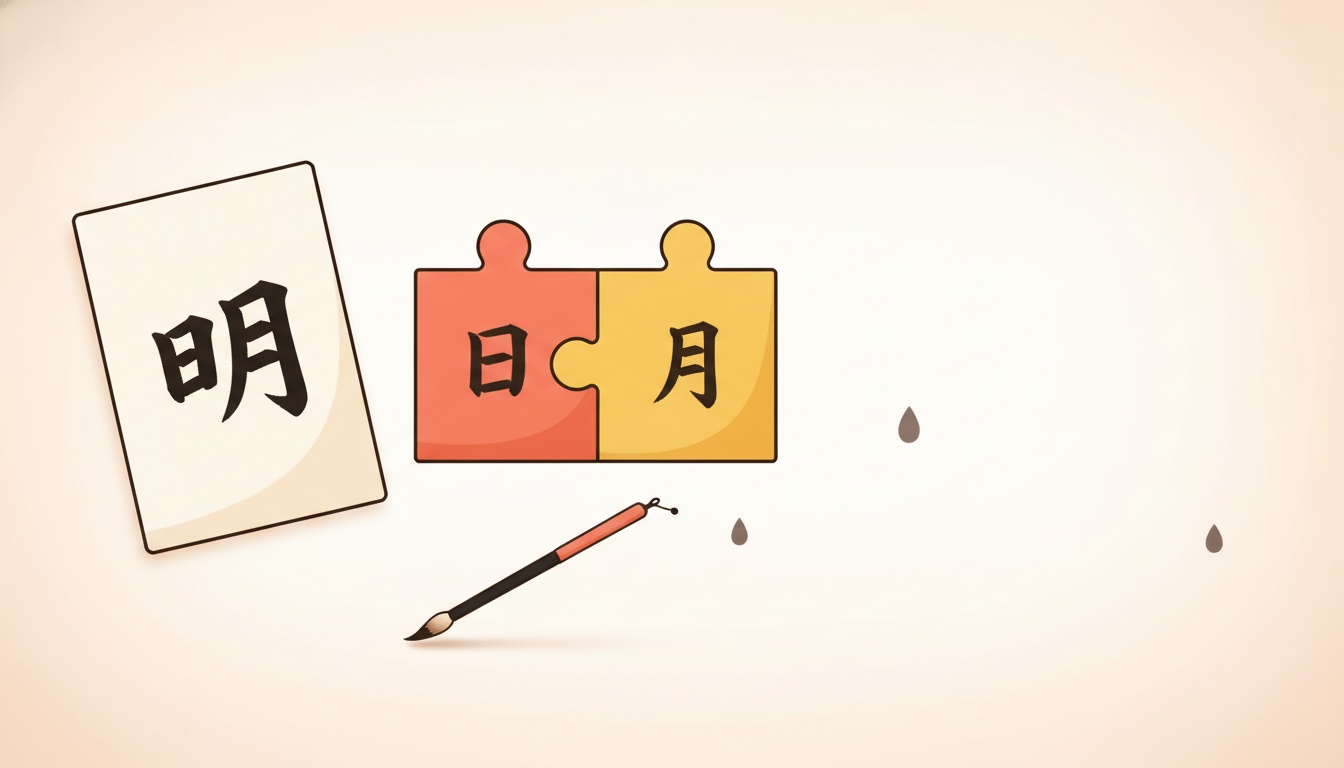
One radical will actively try to trick you: 月. It means "moon" in 明 (míng, bright) and 朋 (péng, friend), but in body-part characters like 脸 (liǎn, face) and 胖 (pàng, fat) that same 月 is actually a squashed 肉 (ròu, flesh). Two origins, one shape. When you see 月 on the left of a character about the body, read it as flesh, not moon.
Start here: the twenty radicals that pay off first
You don't learn 214 radicals. You learn the handful that show up constantly, and you let the rest arrive as you meet them. Sorted by how many common characters they appear in, these are the ones to front-load:
| Radical | Meaning | Shows up in |
|---|---|---|
| 氵(水) | water | 河 hé, 海 hǎi, 洗 xǐ |
| 亻(人) | person | 你 nǐ, 他 tā, 住 zhù |
| 扌(手) | hand, action | 打 dǎ, 找 zhǎo, 拿 ná |
| 口 | mouth, eat, speak | 吃 chī, 叫 jiào, 唱 chàng |
| 女 | woman | 妈 mā, 姐 jiě, 好 hǎo |
| 忄(心) | heart, emotion | 忙 máng, 怕 pà, 情 qíng |
| 讠(言) | speech | 说 shuō, 语 yǔ, 请 qǐng |
| 木 | tree, wood | 树 shù, 林 lín, 桌 zhuō |
| 火(灬) | fire, heat | 烧 shāo, 热 rè, 灯 dēng |
| 日 | sun, day | 明 míng, 时 shí, 晴 qíng |
| 钅(金) | metal | 钱 qián, 铁 tiě, 银 yín |
| 艹 | grass, plant | 花 huā, 茶 chá, 菜 cài |
| 宀 | roof, house | 家 jiā, 安 ān, 室 shì |
| 辶 | walk, movement | 这 zhè, 过 guò, 边 biān |
| 目 | eye | 看 kàn, 眼 yǎn, 睛 jīng |
| 贝(貝) | shell, money | 贵 guì, 财 cái, 购 gòu |
| 纟(糸) | silk, thread | 红 hóng, 线 xiàn, 纸 zhǐ |
| 饣(食) | food | 饭 fàn, 饿 è, 饱 bǎo |
| 虫 | insect | 蚊 wén, 蛇 shé |
| 疒 | sickness | 病 bìng, 疼 téng |
A memory hook for the odd one out: 贝 is a cowrie shell, which ancient China used as money. That's why characters about wealth, cost, and buying (贵 expensive, 财 wealth, 购 to purchase) all carry a shell. The etymology is the mnemonic.
Try it in Conversa
Practice with AI characters who adapt to your level and give real-time feedback.
Try Conversa FreeWhen radicals lie to you
The character 我 (wǒ, I/me) originally depicted a hand-held weapon, not anything to do with the self. That's the first thing to know about the system: it doesn't always decode cleanly, and knowing where it fails keeps you from throwing it out the first time it does.
我 belongs to a set of characters borrowed purely for their sound, with no meaning logic left to read. 来 (lái, to come) started as a drawing of wheat. 北 (běi, north) was two people standing back-to-back. You can't decode these from a radical. Just memorize them as the high-frequency exceptions they are.
Then there's the counterintuitive filing. The traditional radical of 相 (xiāng/xiàng) is 目 (eye), not the 木 (tree) that grabs your attention first. And 问 (wèn, to ask) is filed under the small 口 (mouth) tucked inside, not the big obvious 门 (mén) framing it, because 门 is actually the phonetic there. Dictionaries don't always pick the part you'd expect.
Finally, some phonetics have drifted over the centuries. 海 (hǎi, sea) is built on 每 (měi), which no longer sounds much like it. 给 (gěi, to give) sits on 合 (hé), same story. The sound clue got you into the neighborhood; it just won't always land you on the doorstep.
You don't need a paper dictionary anymore
Older textbooks teach a brutal lookup ritual: identify the radical, count its strokes, find its section, then count the character's remaining strokes to locate it in a list. For a beginner who can't yet tell which part is the radical, that's a maze.
Skip it. Pleco, the dictionary most serious learners use, lets you draw a character with your finger or point your phone's camera at it and read it instantly. Your phone's built-in handwriting keyboard does the same. So why bother learning radicals if the phone finds the character for you? Because the phone tells you what a character is. Radicals tell you why. When you can see that 请 is speech-plus-qīng, you remember it. When you just look it up, you forget it by lunch.
Read one sign, not one thousand characters
The next time a Chinese character stops you, don't try to swallow it whole. Split it. Find the radical, ask what zone of meaning it points to, find the other part, ask what it might sound like. You'll be wrong sometimes. The drifted phonetics and the borrowed characters will trip you. But you'll be building the habit that separates people who read Chinese from people who memorize it: seeing 河 and thinking "water, on the left, of course" before you've even reached for a dictionary. Point at the three drops of water on the next menu you see. That's the whole method, starting now.