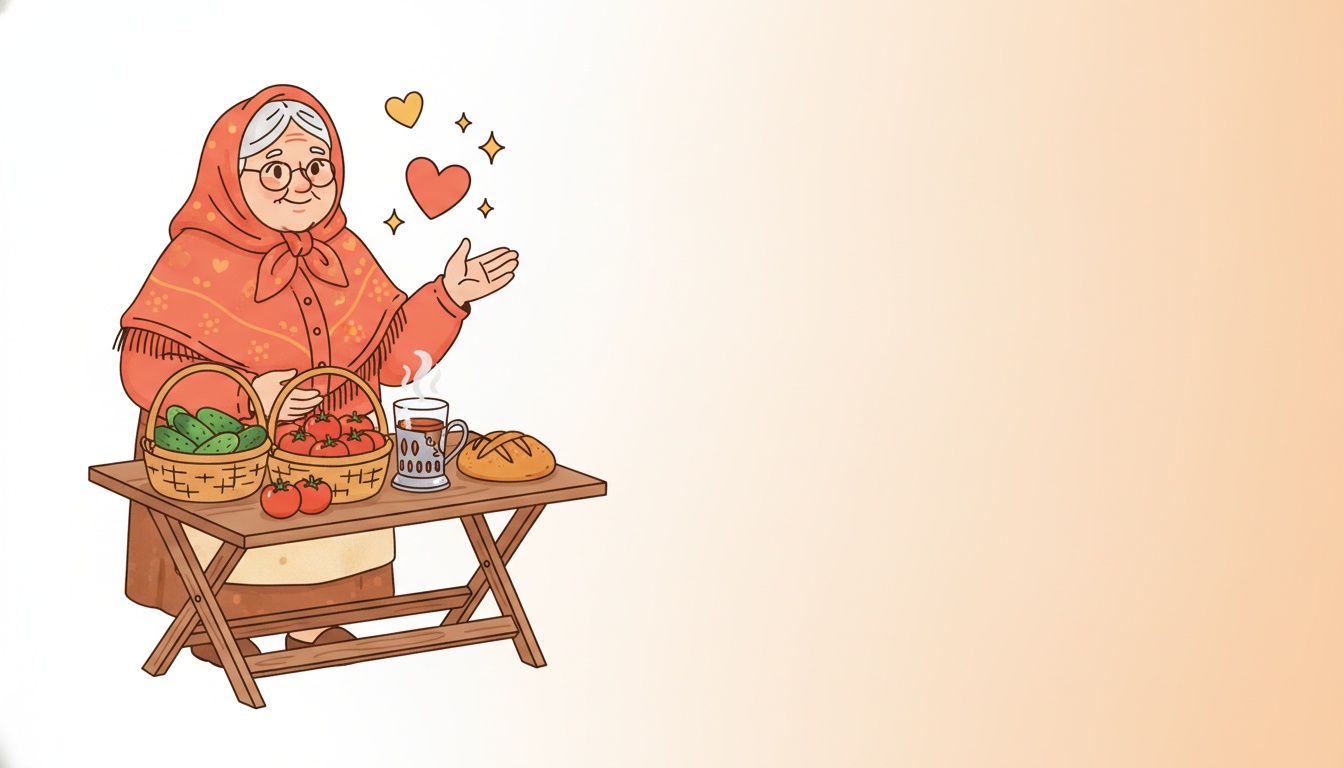
At a Russian market, a woman behind a folding table stacked with vegetables calls out «огу́рчики, помидорчики!» to everyone walking past. Your textbook says огурчик is "little cucumber" and помидорчик is "little tomato."
So you look at the cucumbers. They are normal-sized cucumbers. Some of them are enormous. Nobody is confused except you.
She isn't describing the size of her produce. She's being friendly, the way an English-speaking vendor might say "fresh cukes, lovely tomatoes here." The diminutive carries warmth, not a measurement. And that gap between what the suffix looks like and what it does is the single most useful thing to understand about how Russians actually talk.
The mistake English speakers make: hearing "small" when Russians mean "warm"
English trains you to read -ик, -очка, and -ок as "little" or "-y," like doggy or kitchen-ette. So when you meet до́мик, your brain files it as "small house." But a до́мик can be a perfectly normal cottage that the speaker feels cozy about, and a чаёк can be a full mug of tea. The suffix is carrying feeling, not dimensions (Russificate).
This is the same trap Russian sets with its reflexive verbs, where one -ся ending does about six different jobs. One suffix, many meanings, and size is only one of them. Most of the time the meaning is warmth, affection, coziness, or politeness. Occasionally, with a different suffix, it flips to contempt. Get that spectrum and you can decode almost any diminutive you hear, even ones you've never seen before.
At the table: why food and drink go diminutive
Offer a Russian guest tea with «Хо́чешь чай?» and it's fine, but «Хо́чешь чайку́?» is the version that sounds like home (Russian Enthusiast). Same tea. The -ёк ending turns a flat offer into a warm one. This is the hospitality register, and once you notice it you'll hear it all over a Russian kitchen.
The whole table spreads out in diminutives. Bread becomes хле́бушек, which Wiktionary literally files under "endearing terms" (Wiktionary). Cheese, sausage, and cucumber follow the same instinct:
- хлеб → хле́бушек (bread)
- сыр → сырок (cheese)
- колбаса́ → колбаска (sausage)
- огуре́ц → огу́рчик (cucumber) (Wiktionary)
- помидо́р → помидорчик (tomato)
Two of these have a second life you should know about. Сырок isn't only "little cheese"; it's also the name for those glazed curd snacks in foil you find in every Russian fridge. And «как огу́рчик» ("like a little cucumber") is a set phrase meaning fresh and full of energy, the way English says "fit as a fiddle." Neither one has anything to do with a small vegetable.
The suffix toolkit, as patterns not rules
Су́мка becomes су́мочка, дом becomes до́мик, друг becomes дружо́к. You don't derive these by formula, you collect them. Here are the workhorses, each with one example:
- -очк-/-ечк-: су́мка → су́мочка (handbag), Та́ня → Та́нечка
- -ик/-чик: дом → до́мик (house), стол → сто́лик (table)
- -ок/-ёк: друг → дружо́к (pal), чай → чаёк (tea)
- -ушк-/-юшк-: хлеб → хле́бушек (bread)
- -еньк-/-оньк- (for adjectives): ма́ленький, бе́ленький, тёпленький (soft, affectionate versions of "small," "white," "warm")
One honest warning: which suffix a word takes is mostly fixed by convention, not derivable from a rule. Дом wants -ик, друг wants -ок, and you can't reason your way to which. Treat the endings as things you recognize and collect, not a machine you feed a noun into. And don't overreach: ма́ленький ("small") does not become малю́сенький by adding -еньк-. Малю́сенький ("teeny") is a separate colloquial intensifier that happens to look related (Wiktionary).
Asking a favor: how diminutives soften a request
Say «Секундочку!» instead of «Секу́нду!» and you've done in one word what English does with tone of voice. Both mean "just a second," but the diminutive one lands friendlier, less like an order. Its sibling «Минуточку!» works the same way for "one moment." These are the diminutives an English speaker probably needs first, because they smooth over the exact moments where you're making someone wait or asking them for something.
Money gets the same treatment. Де́нежки is "money" with the edges filed off, warmer and more casual than plain де́ньги (Wiktionary). And a проблема shrunk to пробле́мка signals "just a little problem, nothing to worry about," which can be genuinely reassuring or quietly dismissive depending on who's saying it.
One grammar note so you don't get tripped up: the -у on секундочку and минуточку is just the accusative case ending, the same one you'd meet in any Russian case chart. It's the object of an implied "wait." It isn't part of the diminutive.
Try it in Conversa
Practice with AI characters who adapt to your level and give real-time feedback.
Try Conversa FreeThe dark twin: when the same trick turns dismissive
Attach -ишк- to город and you get городи́шко, a "crummy little town." A доми́шко is a "hovel," and людишки is a sneering word for the "little people" who don't matter (Wiktionary). A воришка is a petty, contemptible thief. Same machinery as чаёк and огу́рчик, opposite feeling.
The classic pair that shows the whole spectrum is старичо́к versus старика́шка. Both come from стари́к ("old man"). Старичо́к is fond, the word you'd use for a sweet old grandpa. Старика́шка is nasty, closer to "geezer" (Transparent Language). The root is identical. The suffix carries the entire judgment.
I'll flag one honest limit here: -ишк- leans pejorative but isn't guaranteed to be. Сынишка ("sonny," for a small boy) can be perfectly warm. Tone and context still get a vote. But if a Russian attaches -ишк- to a town, a house, or a group of people, assume they're looking down on it.
How much is too much?
Pile чаёчек onto сырок onto минуточку in a business email and you don't sound warm, you sound saccharine or sarcastic. Native speakers know exactly how much sugar a sentence can hold, and a foreigner who over-sweetens gives themselves away instantly.
A rough guide. Warm and correct: offering food, soothing a kid, softening a small favor. Cloying and wrong: formal writing, work emails, anything official. Actively sarcastic: dumping affectionate suffixes on an adult who's annoying you, which Russians absolutely do on purpose. When you're not sure, the safest place to start is names. The ladder from Ива́н to Ва́ня to Ва́нечка is well-worn and low-risk (East Slavic name, Wikipedia): Ва́ня for a friend, Ва́нечка when you're being tender. Practicing that warmth out loud with an AI conversation partner like Conversa is a low-stakes way to feel where the line is before you're standing at a real Russian dinner table.
The one question that decodes them all
Next time you hear a Russian shrink a word, don't ask "why is that small?" Ask "warmer or nastier?" That single question sorts almost every diminutive you'll meet: чаёк and огу́рчик land on the warm side, городи́шко and людишки on the nasty side, and the size of the actual cucumber never really mattered. The woman at the market wasn't selling you small vegetables. She was selling you a good mood, one suffix at a time.