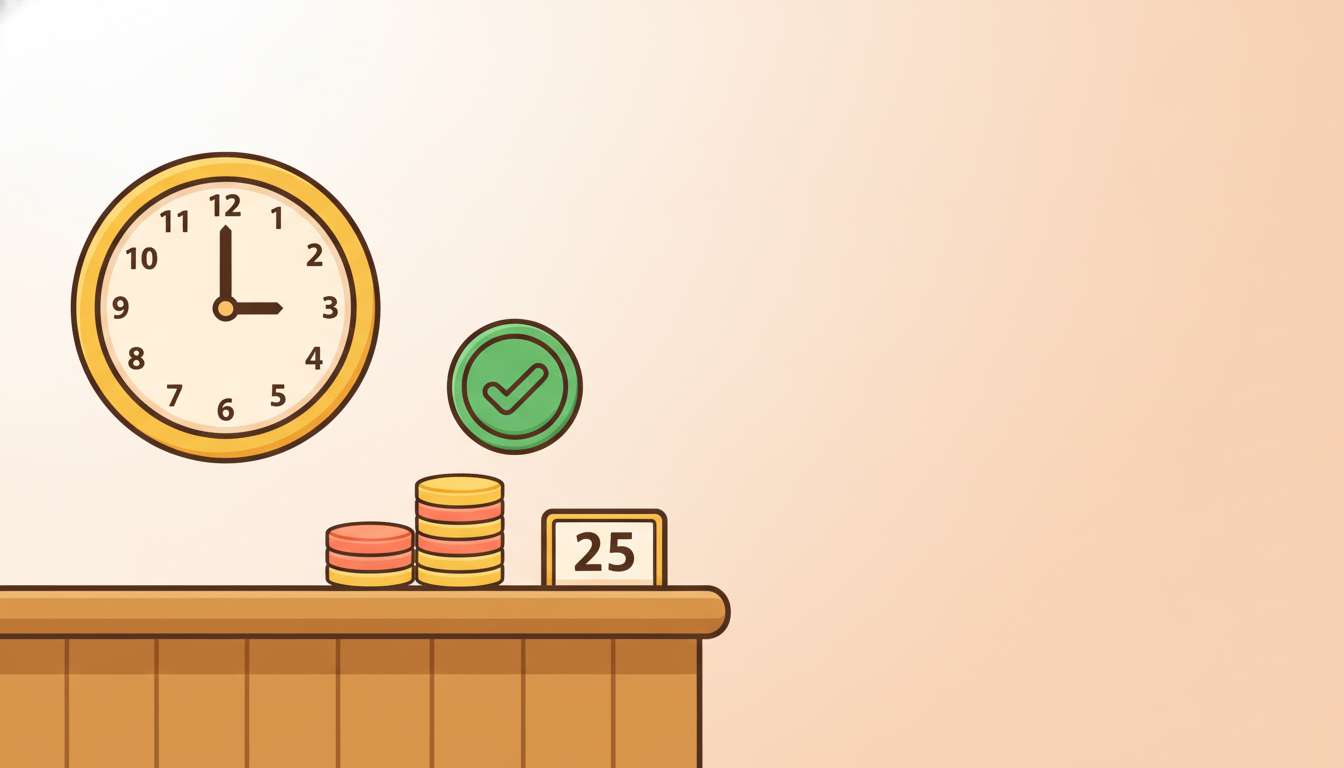
You learned to count to a hundred in a weekend. Один, два, три, четыре, пять. It felt like the one easy win Russian was ever going to hand you. Then you stood at the kassa in a grocery store, the cashier said the total, and the word on the end of the number kept moving: рубль, рубля, рублей. Same coin, three different endings. You knew every number in the sentence and still couldn't tell what was happening to the noun behind it.
Here's the thing nobody puts at the top of the chapter. In Russian, the number doesn't just sit next to the noun. It reaches over and decides what case the noun goes into. Get that one idea and the cashier stops sounding like she's speaking in code.
The one rule nobody states plainly
Count hours and watch the noun change three times: один час, два часа́, пять часо́в. The number is choosing the case each time.
- 1 → nominative singular: оди́н час (one hour)
- 2, 3, 4 → genitive singular: два часа́, три часа́, четы́ре часа́
- 5 and up → genitive plural: пять часо́в, де́сять часо́в
Why the genitive at all? It's Russian's "of" case, the one that does quantity and portions. When you say пять часо́в you're literally saying "five of hours," the way English keeps "of" in "a couple of hours." Russian just makes the noun carry that job in its ending instead of in a separate word. (If the six cases are still a blur, here's what each one is actually for.)
So the whole game is: look at the number, pick one of three buckets, put the noun in that shape. One, then two-through-four, then five-and-up.
Walk the clock from one to five
час, два часа́, три часа́, четы́ре часа́, пять часо́в. Read that out loud. The noun visibly shifts shape three times in five steps, and you didn't touch a declension table to see it.
Notice the stress sliding to the right as you go: ча́с, but часа́, then часо́в. That jump is its own small trap, because Russian doesn't print stress marks in normal text and the vowel underneath changes sound when it moves (the same reduction that turns молоко into "malako"). The ending tells you the grammar; the stress tells you how to actually say it. Per the Wiktionary entry for час, that final-syllable stress in часа́ and часо́в is the standard pattern, not an accent you can skip.
два or две? The split the first two numbers make
два стола́ but две кни́ги. Same number, two spellings, and the noun decides which one you use. два is for masculine and neuter nouns (два стола́, два окна́), две is for feminine ones (две кни́ги, две мину́ты). The Wiktionary usage notes for два spell this out: два and две both still pull the noun into the genitive singular, they just disagree about gender on the way.
Here's the mercy: only the first two numbers care about gender. оди́н splits three ways (оди́н, одна́, одно́), два splits two ways (два, две), and from три upward nobody bothers. три, четы́ре, пять, со́рок — one form each, regardless of what they're counting. You meet this split constantly with money, because рубль is masculine but копе́йка is feminine: оди́н рубль but одна́ копе́йка.
At the register: rubles and kopeks
рубль → два рубля́ → пять рубле́й. This is the version of the rule you'll hit most, because you meet it at every price tag and every change-counting moment. The declension of рубль runs рубль (1), рубля́ (2–4), рубле́й (5+); kopeks run the feminine track, одна́ копе́йка, две копе́йки, пять копе́ек.
Drill the money, not abstract nouns. "Сто два́дцать рубле́й" comes out of a cashier's mouth ten times a day, and once your ear expects рубле́й after a big number, the rule has moved from your notebook into your reflexes.
Try it in Conversa
Practice with AI characters who adapt to your level and give real-time feedback.
Try Conversa FreeBig numbers only listen to their last word
два́дцать оди́н рубль, not рубле́й. A 21-ruble price tag takes the nominative singular, exactly like plain 1, because compound numbers obey only their final word. Run the twenties:
- два́дцать оди́н рубль (21) → nominative singular, like 1
- два́дцать два рубля́ (22) → genitive singular, like 2
- два́дцать пять рубле́й (25) → genitive plural, like 5
The Wiktionary note on двадцать два confirms it governs the genitive singular just like bare два. And there's no extra rule to learn here: you never need a separate pattern for big numbers. 121 behaves like 1, 1,000,002 behaves like 2. Read the last word, ignore everything in front of it.
The teens are the one trap
оди́ннадцать часо́в, not часа́. The teens look like they should follow their last digit, but 11 through 14 quietly break ranks and take the genitive plural anyway: оди́ннадцать, двена́дцать, трина́дцать, четы́рнадцать all get the 5-and-up treatment. The Wiktionary entry for одиннадцать confirms it governs the genitive plural, and Wikipedia's grammar summary hedges its own rule for exactly this reason, saying "most numbers ending with 2, 3, 4" take the genitive singular (Russian grammar). The carve-out is the teens. Twenty-two is два again, but twelve is not.
Counting years breaks the word itself
оди́н год, два го́да, пять лет. Look at that last one. Not "годо́в", not anything built from год at all. The moment you hit five years, Russian swaps in a completely different word: лет, which is the genitive plural of ле́то ("summer"). The pattern still holds (5+ takes the genitive plural), but here it changes the whole noun, not just its tail. The Wiktionary entry for год records the suppletion plainly: after a number, the genitive plural is лет, borrowed from ле́то. So you count оди́н год, два го́да, три го́да, четы́ре го́да, and then пять лет, ше́сть лет, со́рок лет. It's the one place the counting rule reaches past the ending and replaces the word.
The escape hatch when the whole phrase moves
к двум часа́м, and suddenly the genitive-singular-versus-plural headache is gone. Everything above only bites when the number-noun phrase is the subject or the direct object, sitting in the nominative or accusative. The instant the phrase moves into another case, number and noun both go into that case together and the messy three-way split collapses.
- dative: к двум часа́м (by two o'clock)
- prepositional: о пяти́ рубля́х (about five rubles)
- instrumental: с тремя́ детьми́ (with three children)
The Wiktionary note on пять puts it cleanly: in cases other than nominative and accusative, the number "governs the corresponding plural case of the noun." Translation: the scary rule is contained. It only runs at the cash register and the clock, the two places you happened to need it most.
What to actually do with this
час, часа́, часо́в — say all three out loud the next time you glance at a clock. Don't memorize the table; catch yourself in the act. Every time you look at a clock or hand over money, say the number-and-noun together and watch which of the three shapes the noun lands in. After a couple of weeks of paying attention at exactly the moments the rule fires, два часа́ and пять часо́в stop being a choice you compute and start being the only thing that sounds right. An AI conversation partner like Conversa is useful here precisely because it'll keep throwing prices and times at you until the endings are automatic, which is the only way this particular rule ever sticks. The cashier was never speaking in code. She was just letting the number do its job.