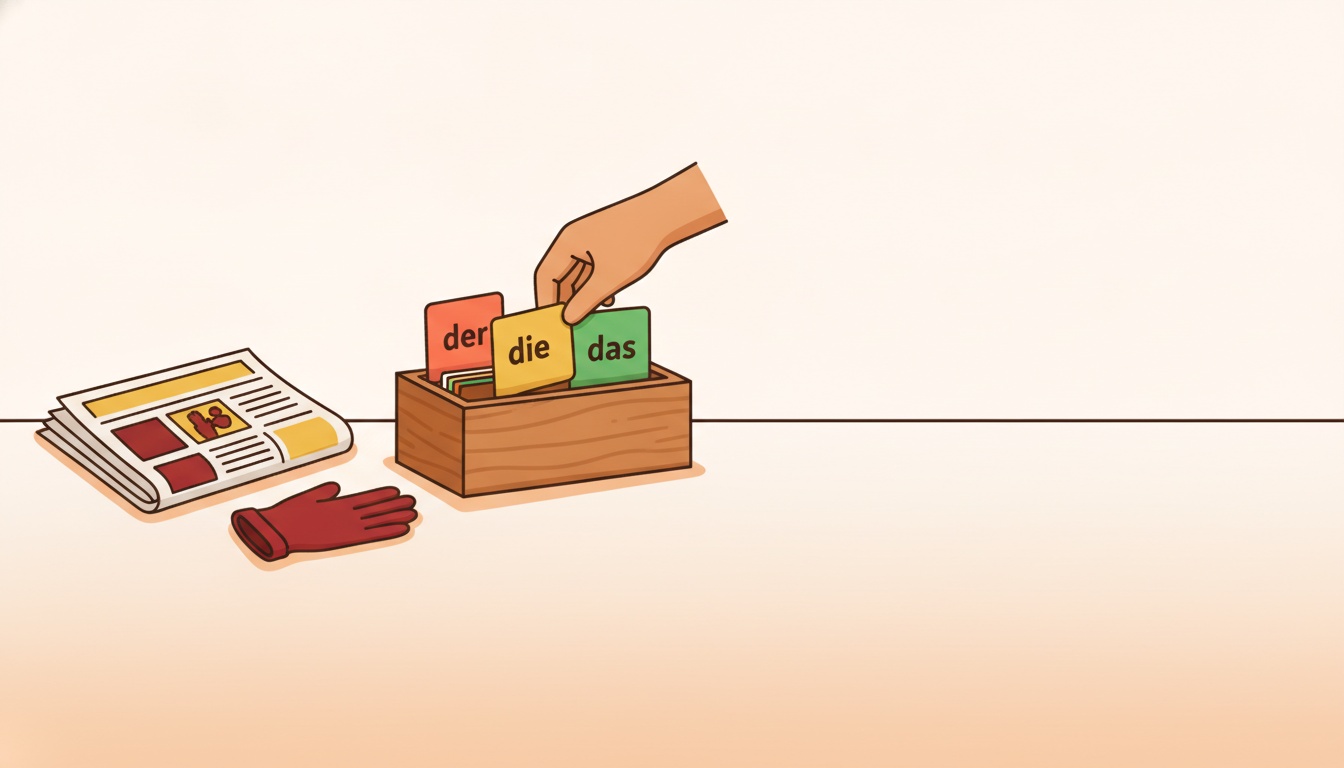
Die Zeitung is feminine. Das Mädchen, the word for "girl," is neuter. If those two facts feel like they were assigned by a coin flip, you've been told the usual lie about German: that gender is random and you just have to memorize every noun cold.
That's half true at best. Zeitung ends in -ung, and almost every -ung word in the language is feminine. Mädchen ends in -chen, and every -chen word is neuter, even when the thing it names is a teenage girl. The article isn't random. It's often hiding in the last few letters of the word. Learn the endings that pay off and you can predict der, die, or das for a big chunk of the nouns you'll meet, instead of flipping that coin every time you open your mouth.
Why "just memorize it" is bad advice
German has three genders, and each one comes with its own word for "the": der (masculine), die (feminine), das (neuter). English threw all of that out centuries ago and kept one flat "the," so there's nothing in your native language to lean on.
The standard advice is to memorize the article with every single noun, one at a time, forever. That advice isn't wrong so much as incomplete. What nobody tells beginners is that German nouns split into two piles: the ones whose gender you can read straight off the ending, and the short, stubborn ones you genuinely have to memorize. Most of the words you'll use every day live in the first pile. The trick is knowing which endings to trust.
The feminine suffixes that do the heavy lifting
Die Freiheit (freedom), die Möglichkeit (possibility), die Freundschaft (friendship), die Universität (university), die Nation (nation). Five nouns, five different topics, one gender. They're all feminine because of how they end.
This is the single highest-payoff rule in German gender, because these suffixes attach to abstract and everyday nouns you'll reach for constantly. The reliably feminine endings:
- -ung: die Zeitung (newspaper), die Wohnung (apartment), die Erklärung (explanation)
- -heit / -keit: die Gesundheit (health), die Schwierigkeit (difficulty)
- -schaft: die Gesellschaft (society), die Mannschaft (team)
- -tät: die Aktivität (activity), die Qualität (quality)
- -ion: die Station (station), die Funktion (function)
- -ie / -ei / -ur: die Familie (family), die Bäckerei (bakery), die Kultur (culture)
There's also a softer rule: most nouns ending in a plain -e are feminine, like die Lampe, die Blume, die Katze. Treat that one as a good bet, not a guarantee. It leaks (you'll see why in a minute), but for guessing on the fly it'll be right far more often than not. The University of Texas's open German grammar Grimm Grammar lays out these suffix groups if you want the fuller list.
The neuter giveaway: -chen and -lein
Das Mädchen. A girl is grammatically an "it" in German, and this is the example every learner trips over. The reason is mechanical: -chen is a diminutive ending, the "little" marker, and -chen and -lein are always neuter. The suffix wins, every time, no matter what the word means. So das Brötchen (bread roll), das Häuschen (little house), and yes, das Mädchen.
This is the most predictable rule in the whole system, with zero exceptions, so it's worth locking in early. A few other endings are usually neuter, though these leak more than -chen does: -ment (das Dokument, das Instrument, but watch der Moment), -um (das Datum, das Museum), and -ma (das Thema, das Klima, though die Firma breaks it). Jakub Marian's reference on German noun gender collects these with plenty more examples.
When -er means masculine, and when it doesn't
Der Lehrer (teacher), der Fahrer (driver), der Verkäufer (salesperson). When you take a verb and tack on -er to mean "the person who does this," the result is masculine. That covers a huge number of job and doer words. (Some loanwords in -er happen to be masculine too, like der Computer, but don't lean on that, the reliable version is the doer rule.)
Here's where you have to be careful, though, because this is the rule beginners overextend. -er is only a safe bet for agent nouns, the doers. Plenty of ordinary -er words break it: die Mutter (mother), die Schwester (sister), die Butter (butter), das Fenster (window), das Wasser (water), das Messer (knife). So "ends in -er, must be der" will burn you. "Names a person who does something, ends in -er, probably der" will not.
Two more reliable masculine buckets while you're here: the days, months, and seasons are all masculine (der Montag, der Januar, der Sommer), as are most weather words (der Regen, der Wind). Jakub Marian's gender reference catalogs these semantic groups alongside the suffix rules.
The free win: compound nouns inherit the last word
Der Handschuh means glove. It's built from die Hand (hand) and der Schuh (shoe), and its gender comes from Schuh, the last piece, not Hand. That's the rule for every compound noun in German, and German builds compounds constantly: the gender is always the gender of the final element.
So once you know die Tür (door), you already know die Haustür (front door). Know das Zimmer (room) and you've got das Schlafzimmer (bedroom) and das Wohnzimmer (living room) for free. Know der Tisch (table) and der Nachttisch (nightstand) costs you nothing extra. German nouns can get absurdly long, but for gender you only ever have to look at the word on the end.
Try it in Conversa
Practice with AI characters who adapt to your level and give real-time feedback.
Try Conversa FreeThe exceptions actually worth memorizing
Das Mädchen, der Junge, die Mutter, das Fenster: those are the ones worth burning into memory. Most guides bury them in a thirty-row table of exceptions, which is how you end up memorizing nothing. You don't need all of them. You need the handful that show up in real sentences.
The big one is das Mädchen and das Fräulein, neuter despite naming females, which you already understand now: the -chen and -lein endings override the meaning. Then there's der Junge (boy), worth flagging because it ends in -e but is masculine, breaking the "-e is feminine" tendency. And keep the -er traps from earlier in your back pocket: die Mutter, das Fenster, das Wasser, das Messer. That's a short list you can actually hold in your head, instead of a wall of edge cases that makes you give up on the rules entirely.
The one habit that fixes gender for good
None of this works if you learn nouns naked. When you meet a new word, learn it as der Tisch, never bare Tisch. The article is part of the word. Store them apart and you'll know a hundred nouns and the gender of none of them.
A trick that helps: color-code your flashcards or notes by gender, say blue for der, red for die, green for das. After a few weeks your memory starts filing words by color, and the article comes back attached. Deutsche Welle's free German course drills vocabulary with the article built in from the first lesson, which is the right instinct.
And the suffix rules only stick once you've said them out loud enough times that die Zeitung feels wrong any other way. That's the gap between recognizing a rule and owning it. Practicing with a patient conversation partner who lets you fumble der/die/das in real sentences (Conversa is an AI one you can talk to without feeling judged) is how the rules move from a list you've read to something your mouth does automatically.
Where to start
You don't need all three genders memorized cold before you can speak. You need two things: the suffix radar, and the habit of never storing a noun without its article. Start with the feminine endings, -ung, -heit, -keit, -schaft, -tät, -ion. They're the highest-frequency, highest-payoff group, and once they're automatic you've already de-randomized a big slice of the language. The stubborn one-syllable words can wait. They're a smaller pile than you've been led to believe.
If you've worked on gender in another language, the same instinct transfers. Our guide to French noun gender patterns runs the same play for le and la, and the French partitive articles post is the next step once the articles themselves stop tripping you up.