Your friend Katya has a driving test in an hour. You do the warm, obvious thing: you wish her good luck, and when she wishes you well back, you say "спасибо." Two sentences, two superstitions tripped. In Russian, wishing someone plain luck before a real trial is the beginner move, and thanking someone for a luck-wish is the thing that supposedly cancels it. Katya won't correct you. She'll just clock you as someone who didn't grow up with the rules.
These aren't dusty folklore about black cats and spilled salt. They're live reflexes in daily speech, and the tricky part for English speakers is that the polite English instinct is usually the wrong one, the same reflex that makes Russian false friends so easy to trip over. Here are the well-wishing phrases that matter, each paired with the reply, so you stop accidentally jinxing people you like.
Before a big moment, wish "neither down nor feather"
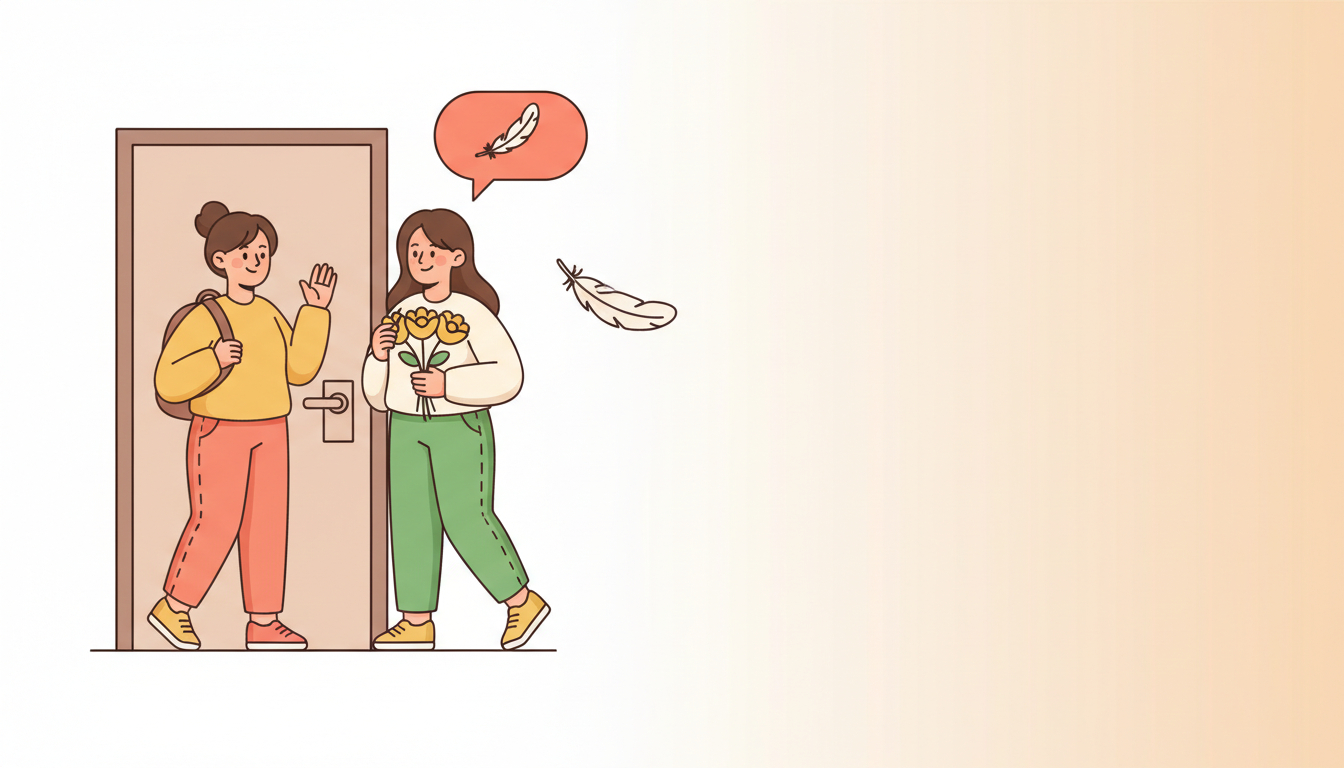
Katya's driving test is exactly the situation for ни пуха ни пера (ni púkha ni perá), literally "neither down nor feather." It's the Russian "break a leg." The traditional explanation is that it started with hunters: wishing someone a good catch out loud was thought to jinx the hunt, so you wished them the opposite, no fur and no feathers, to throw the evil spirits off the scent (Wiktionary). You use it before exams, interviews, auditions, surgery, a first date, anything with stakes.
One thing worth getting right, because a lot of blog posts overstate it: plain удачи (udáchi, "good luck") is completely normal. You can say удачи to a coworker heading into a meeting and nobody blinks; the reply is an ordinary спасибо (Russian Academy). удачи is not forbidden. ни пуха ни пера is just the superstition-flavored version you pull out for the higher-stakes moments, and using it signals you know the culture, not just the dictionary.
The reply that sounds rude but isn't: "к чёрту"
Someone says ни пуха ни пера to you, and every English instinct fires: спасибо. Don't. The correct reply is К чёрту! (k chórtu), which means "to the devil" (Russia Beyond). Thanking is thought to break the wish. Telling the well-wisher to go to hell is what keeps it intact.
It reads as aggressive on paper. It isn't. On its own, «иди к чёрту» really is a rude "go to hell," but inside this exchange к чёрту is just the ritual answer, said with a smile. Practice it as a pair:
— Ни пуха ни пера! — К чёрту!
That call and response is the whole thing. The wish is easy to memorize; the reply is where learners stall, because you have to override the "say thank you" reflex in real time. Say it out loud a few times until к чёрту comes automatically, or you'll default to спасибо the one time it counts.
Said something hopeful? Spit three times: "тьфу-тьфу-тьфу"
Your coworker asks how the new job is going, and you answer, in English-brain fashion, with unqualified enthusiasm: it's great, the team's amazing, best decision I ever made. A Russian speaker saying the same thing will often tack on тьфу-тьфу-тьфу (tʹfu-tʹfu-tʹfu), the sound of spitting three times over the left shoulder (Wiktionary). It's the Russian "knock on wood," and you can literally knock too: постучать по дереву (postuchátʹ po dérevu).
The logic is the evil eye, сглаз (sglaz). Praising your own good fortune out loud, or having someone praise it for you, is thought to invite it to collapse. So you say the good thing and then immediately undercut it with тьфу-тьфу-тьфу or the full чтоб не сглазить (chtob ne sglázitʹ, "so as not to jinx it"). There's a proverb for the person who celebrates too early: не говори гоп, пока не перепрыгнешь (ne govorí gop), "don't say 'hop' until you've jumped over." It's the Russian "don't count your chickens."
You don't need to believe any of this. Plenty of Russians who'd call themselves rational still add тьфу-тьфу-тьфу out of pure habit, the way English speakers knock on wood without thinking a tree is listening.
Try it in Conversa
Practice with AI characters who adapt to your level and give real-time feedback.
Try Conversa FreeHeading out the door? Sit down and shut up: "присядем на дорожку"
You've got your coat on, keys in hand, taxi outside, and your Russian host says присядем на дорожку (prisyádem na dorózhku), "let's sit down for the road." Everyone sits. In silence. For maybe ten or twenty seconds. Then you get up and go (Wikipedia).
The English instinct at the door is to keep moving, so sitting back down feels like a mistake, like you forgot something. You didn't. It's a small pause before a journey, part practical (a beat to remember what you left behind) and part superstition. If you're the guest, just follow along and sit. Standing there confused while everyone else settles onto the couch is the tell that you're new to this.
The wishes that backfire: flowers, thresholds, early birthdays
You buy a nice bouquet of a dozen roses, because twelve is a "nice round number" in English. In Russia, even-numbered bouquets are for funerals. For anyone living, you give an odd number: 5, 7, 9 (Russia Beyond). Above roughly a dozen nobody's counting, but for a small hand-bought bunch, count. A few more places the generous English move backfires:
- Your friend opens the door and you reach across to shake hands or pass the wine. Step inside first. Doing it over the порог (porog, "threshold") is bad luck; the doorway is treated as a boundary you don't conduct business across.
- Their birthday is Saturday, you won't see them, so you wish them happy birthday on Thursday. In Russian custom, заранее не поздравляют: you don't congratulate in advance. Wait for the actual day, even if that means a text at midnight.
None of these are things a Russian friend will lecture you about. They'll just quietly note that you handed them twelve flowers, and file it away.
Why the reply matters more than the wish
The wishes are easy. Any flashcard app will teach you ни пуха ни пера and удачи in an afternoon. The hard part, the part that actually marks you as an outsider the same way mixing up ты and вы does, is the response in the moment: saying к чёрту instead of спасибо, adding тьфу-тьфу-тьфу after you brag, sitting down when every muscle wants to walk out the door. Those are reflexes, and reflexes only come from saying the words out loud enough times that the wrong instinct stops firing first.
That's the case for rehearsing these as spoken exchanges rather than reading them once and nodding. Run the ни пуха ни пера / к чёрту call and response until it's automatic, and you'll have it ready the day a real Russian speaker wishes you luck and watches to see what you say back.