Hear a native speaker say the name Paco, and to an English ear it sounds "more like 'Bah-co' than 'Paw-co,'" as the teacher Trevor Huxham puts it. Now say it yourself. Odds are your P arrives with a little burst of breath that no native speaker puts there.
That burst is called aspiration. English adds it to p, t and k at the start of a word. Spanish doesn't, and that puff is one of the things that marks English-accented Spanish. Your vowels can be clean and your R can be coming along, and pero, tú and casa can still give you away.
This post covers the air (how to stop the puff), the tongue (where the Spanish t actually sits), and the ear (why native Paco sounds like Baco to you, and what that does to your listening).
Why your Spanish p, t and k carry a puff of air
Hold your palm an inch from your mouth and say pin, tin, kin. You'll feel three small gusts. English releases p, t and k with a burst of air at the start of a word or a stressed syllable. Wikipedia's English phonology article points to the t in potato.
Phoneticians measure this as voice onset time: the gap between the consonant's release and the moment your vocal folds start buzzing. According to Wikipedia's aspiration article, English aspirated p, t, k run about 60, 70 and 80 milliseconds. Spanish p, t, k run about 5, 10 and 30. That delay is the puff. In Spanish the voice kicks in almost the instant the lips or tongue let go.
Same letter, but the Spanish p releases straight into the vowel with no gust of air.
A twentieth of a second sounds tiny. It isn't, to a listener who grew up without it. A Spanish speaker hears your pero as pero, with an accent attached.
You already make the Spanish p in "spin"
Say spin. Then pin. Palm in front of your mouth again: the first one barely moves the air.
English drops aspiration after an s in the same syllable, which is why spin, stop and skin come out plain (English phonology). The UC San Diego linguist Will Styler makes the same point with sky.
So you own the Spanish sound already. It's the p in spin, the t in stop, the k in scar. The job is moving it to the front of a word. Use a ladder:
- Say spin slowly, five times.
- Say it again, but only think the s. Keep your mouth ready for it.
- Drop the s completely: pin, with the spin air, which is almost none.
- Add a vowel: pino.
- Put it in a phrase: un pino alto.
Run the same ladder for the other two. Stop → top → toma → toma el tren. Scar → car → casa → mi casa.
Step two feels silly. It's also the step that works, because it keeps your mouth in the s-cluster shape while you remove the sound that triggers it.
The tissue test: check it with a strip of paper
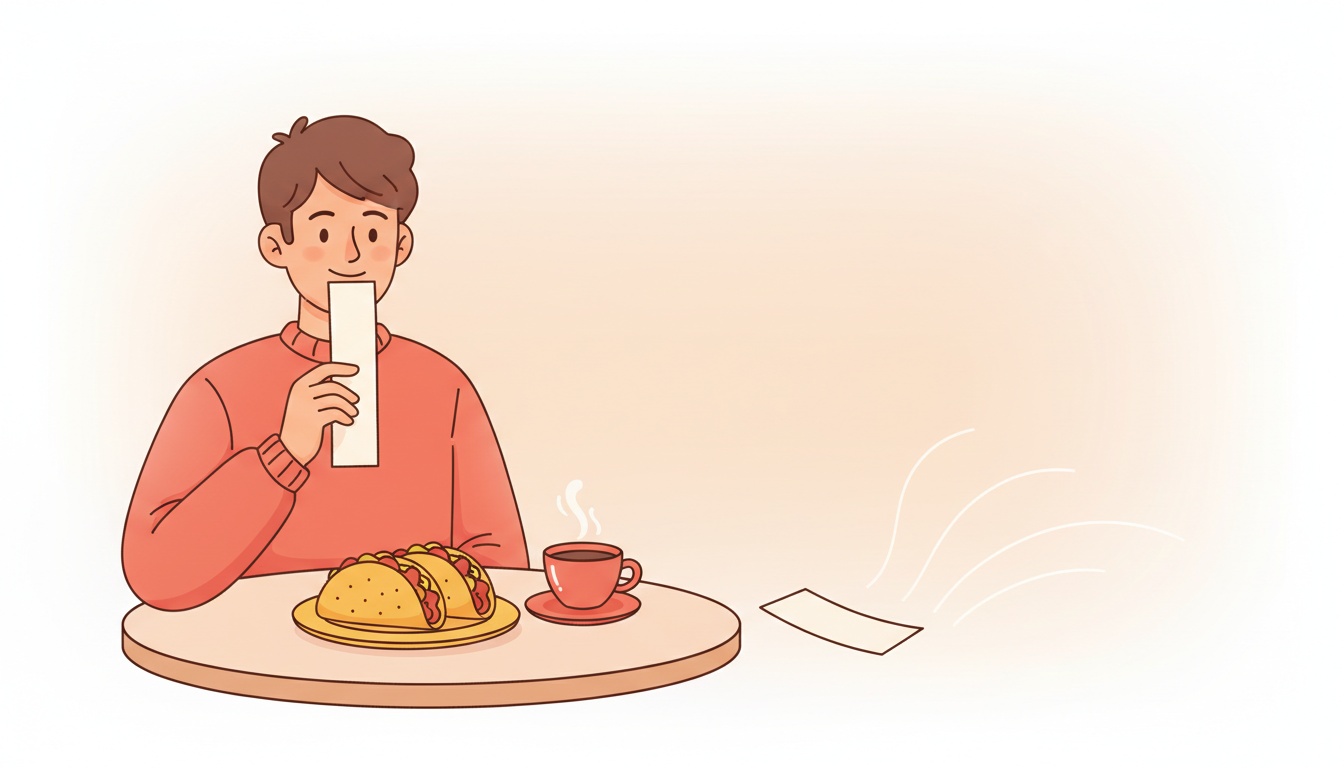
Tear a strip of paper about the width of two fingers (a tissue works too) and hold it just in front of your lips. Say party. The paper jumps. Say wrapper, where the p sits in an unstressed syllable, and it barely moves.
Huxham uses exactly that pair, plus target against laptop. The University of Washington pronunciation textbook I'm All Ears runs the same exercise, calling English p, t, k "plosive" and noting that "Spanish occlusives are not plosive."
Now say para, tía, casa. The paper should stay about as still as it does for spar, star, scar.
One catch. The paper also moves if you're speaking loudly or over-enunciating because you're concentrating. Test at the volume you'd use across a café table.
Where your tongue goes for the Spanish t
Put the tip of your tongue against the back of your upper front teeth and say té. That's the Spanish t. SpanishDict's guide describes it as "the tip of the tongue against the back of the upper teeth," and the I'm All Ears chapter calls it dental, where English t is alveolar: the tongue hits the ridge behind your teeth instead.
Move the contact forward to the teeth and release straight into the vowel.
The two fixes help each other. Once the tip is on the teeth, I find the release gets quicker and there's less puff behind it. If tía still feels breathy, check the tongue before you check the air.
Spanish d sits in the same dental spot, so tía and día differ only in when your voice starts, which is a difference English ears aren't tuned to hear.
Why Paco sounds like "Baco" to English ears
A Spanish p and an English b are nearly the same sound. In a 2016 study in Language and Speech, the researchers Llanos and Francis put English /b/ at around 12 milliseconds of voice onset time and Spanish /p/ at around 14. Spanish /b/ sits at around −97 (that's the stop b you hear after a pause): the voice starts buzzing before the lips even open. (Studies differ by a few milliseconds on the Spanish p; the gap is what matters.)
English ears draw the line between b and p at about 20 milliseconds, so a plain, puff-free Spanish p falls on the b side. A 2023 Journal of Phonetics study of bilingual preschoolers describes the same pattern from the listening side: English-speaking monolinguals "map positive short lag VOT to a voiced category." That's Bah-co.
For you, the listener, it means these pairs can blur in fast speech:
| Native says | Meaning | You might hear | Which means |
|---|---|---|---|
| pata | paw | bata | robe |
| peso | weight | beso | kiss |
| pino | pine | vino | wine |
| tía | aunt | día | day |
| tos | cough | dos | two |
| casa | house | gasa | gauze |
| coma | comma | goma | rubber |
Train your ear to listen for the buzz. Spanish b, d, g after a pause or an m/n start voicing early, so un beso has a hum before the b that un peso doesn't. Between vowels they soften into something airier, which our post on Spanish B and V covers in detail.
On the speaking side, the stakes are lower. A native still hears your aspirated p as p, and nobody will mistake your peso for beso. The puff marks an accent, but it won't flip a word into a different one. That's why I'd fix your vowels first and this second.
To produce the voiced side, hum into it. Say mmm and let it run straight into beso: mmm-beso, then un beso. You should feel your throat buzzing before your lips open. That early buzz is what separates un beso from un peso.
Try it in Conversa
Practice with AI characters who adapt to your level and give real-time feedback.
Try Conversa FreeThe cognates where the puff sneaks back
Order a taco and watch what happens. The word is so familiar in English, stressed on the first syllable, that you'll likely say it the English way, puff and all. Cognates carry your English habits along with the spelling, and the ones with a stressed first-syllable p, t or k are the worst offenders.
Borrow the t from 'stack' and the c from 'scar'. No puff on either word.
Some cognates hide a second trap: the stress lands somewhere else. English says CAPital and TELephone, with a strong puff on the first syllable. Spanish says ca-pi-TAL and te-LÉ-fo-no, and the c and t stay plain. Papá is stressed on the end, so the English rule drags a puff onto its second p.
Put these on a short list and say each one with the paper test: taco, pasta, café, capital, teléfono, tomate, papá, paciente, computadora. The same words usually carry a gliding English vowel too, which the Spanish pure vowels post fixes.
Is "aspiration in Spanish" the same as dropping the s?
No. When a Dominican speaker says ¿Cómo e'tá?, the s before the t turns into a breathy h, and that's the "aspiration" some search results for the phrase are actually about. Linguists call that s-aspiration or debuccalization, and Wikipedia's Spanish phonology article records it across southern Spain, the Canary Islands and most lowland Latin America. It's about the s, and it has its own rules in Caribbean and Andalusian Spanish.
At the start of a word, the p, t, k in this post don't vary by region. The same article notes "no dialectal variation" in how Spanish pronounces them. The unaspirated p in Paco is the same in Madrid, Mexico City and Buenos Aires.
How long it takes to lose the puff
In a longitudinal study in Applied Linguistics, Nagle tracked 26 English-speaking beginners of Spanish across two semesters. Most of their voice-onset-time gains came in the first half. The spread was wide: some learners ended up near-native, and some improved their p while their b stayed put.
Two takeaways. In that study most of the progress came in the first semester, so I'd put your effort in early rather than spread it thin. And p and b didn't improve together for everyone, so drill the mmm-beso hum too.
Here's a week that fits in five minutes a day. Monday to Wednesday, run the spin → pin → pino ladder for p, t and k, with the paper. Thursday, say the cognate list, then ten rounds of un peso, un beso.
Friday, read these three lines at normal speed and record them: Mi tía viene el día dos. Tengo tos, no dos tacos. Paco, ¿me pasas la pasta? Play it back next to native recordings of tía, día, tos and dos on Forvo. If tía and día sound different only in the buzz, not the breath, you've got it.