You ask for a zumo de naranja in a café in Guadalajara and the waiter tilts his head. You try again, slower, same word. He still doesn't get it. The word he's waiting for is jugo. You didn't learn bad Spanish. You learned Spain's Spanish, and you're standing in Mexico.
This happens to everyone who learns one variety and then meets the other. You say móvil in Bogotá and get celular. You say ordenador in Lima and get computadora. It feels like your Spanish broke. It didn't. Around 90% of everyday vocabulary is shared across the Spanish-speaking world, and the varieties are mutually intelligible, as Babbel lays out in its guide to the two. What trips you up is the other 10%, and that 10% is loaded with the words you use every single day: food, phones, cars, clothes.
So this isn't a "which Spanish should I learn" article. You already picked one. (If the pick is still open, the sound that decides it is Madrid's th versus Latin America's s in gracias.) This is the swap list for when you have to switch. (There's a third pole this map leaves out, and it's the one most US readers will meet first: the Spanish spoken in the United States, where a pickup is a troca out West and a troque out East.)
Spain vs Latin America Spanish: how big is the vocabulary gap?
A few dozen words. That's roughly the whole gap: high-frequency nouns and verbs that come in two flavors, plus a handful of grammar habits. It's a weekend of noticing, not a new course.
And most of the work is recognition rather than production. If a Mexican says carro and you only ever say coche, the conversation survives fine as long as your ear catches that carro means car. You don't have to switch your own speech to be understood. You have to stop freezing when the other word shows up. Keep that distinction in mind for everything below: the goal is to recognize both, not to relearn one.
Getting around: coche, carro, and the car that isn't a stroller
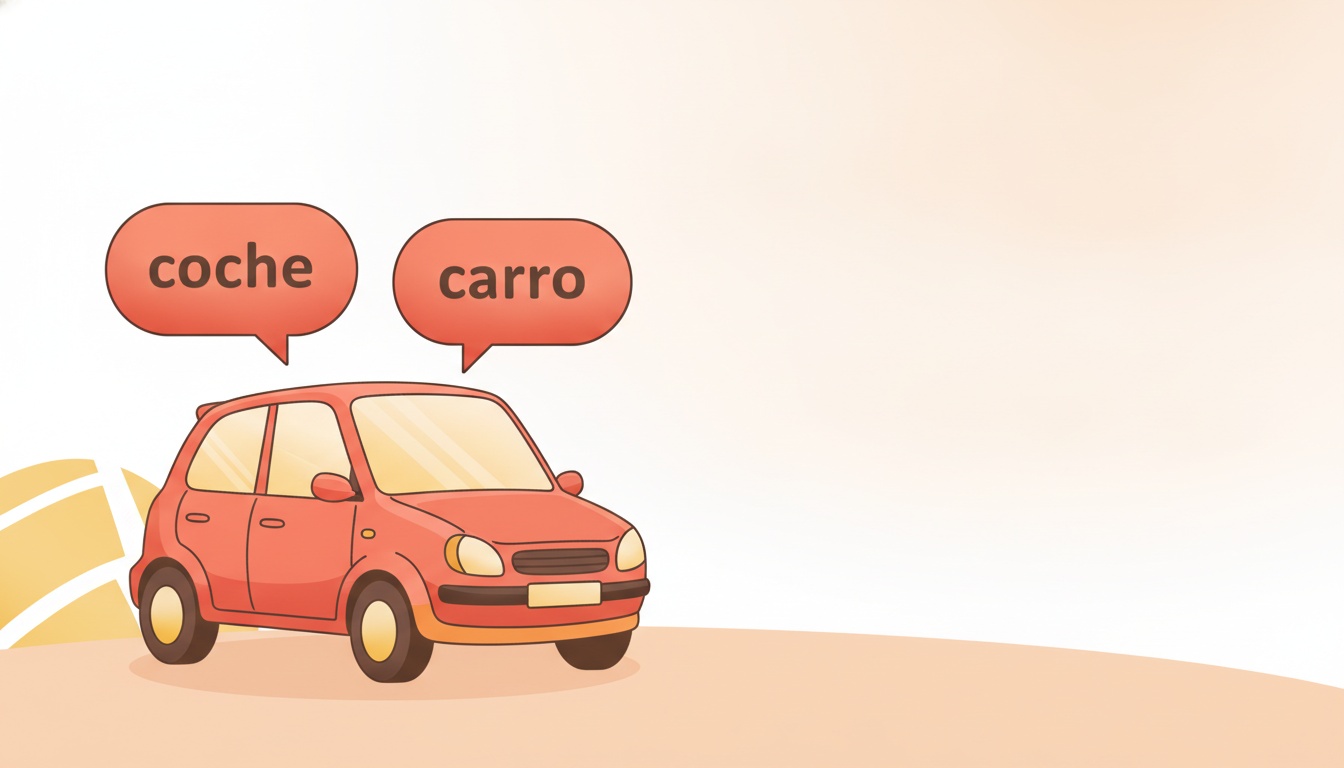
In Spain a coche is a car. In much of Latin America a coche is a baby stroller, and the car is a carro (Mexico, Colombia, Central America, the Caribbean) or an auto (Argentina, Chile, Uruguay). This is the one that produces real confused looks, because both sides think they said something ordinary.
The verbs move too. Spain drives with conducir; most of Latin America drives with manejar. To park is aparcar in Madrid and estacionar across most of Latin America, with parquear in the Caribbean, Central America, and Colombia. If you want one word that works nearly everywhere, estacionar is the safe default.
Then there's the bus, which is where "Latin American Spanish" stops being one thing. It's autobús in Spain, but camión in Mexico (and only Mexico, where camión means truck almost everywhere else), colectivo in Argentina, micro in Chile, and guagua in Cuba, Puerto Rico, and the Dominican Republic. The Open University's course on Spanish regional variation uses exactly this word to show how far a single object can scatter. Your safe bet when you don't know the local term: bus. Almost everyone understands it.
Food and drink: zumo vs jugo, and the plátano problem
Orange juice is zumo in Spain and jugo in all of Latin America, a pairing SpanishDict labels by region on its compare page. Some food splits are that clean. A potato is a patata in Spain and a papa in Latin America. A peach is a melocotón in Spain and a durazno in Latin America. Learn these three and you've covered a surprising share of café and market conversation.
Three clean splits that cover a surprising share of café and market conversation.
A few are narrower than the internet claims. A strawberry is a fresa almost everywhere, including Mexico, but a frutilla in the Southern Cone. That's an Argentina-and-neighbors word, not a general Latin American one, so file it under Buenos Aires, not under "Latin America says."
And one is a genuine trap. A plátano in Spain is the banana you put in your cereal. In much of Latin America a plátano is a plantain, the starchy cousin you fry, and the sweet banana is a banana, a banano, or a guineo. So "quiero un plátano" can get you two different fruits depending on the country. When in doubt, point at the thing.
Tech and phone: móvil vs celular, ordenador vs computadora
In Spain your phone is a móvil; in Lima it's a celular, a distinction Collins' dictionary marks explicitly. It's the word you'll say most often on this whole list, and one of the cleanest splits. Your computer is an ordenador in Spain and a computadora in most of Latin America (a computador, masculine, in Chile and Colombia).
Two of the cleanest splits on the list, and the two words you'll say most often.
These two come up constantly, in every store, every office, every "what's your number" exchange, so they're worth memorizing outright rather than leaving to recognition. If you're switching from Spain Spanish to a Latin American country, celular and computadora are the first two words to move into your active vocabulary.
Clothing and home: where the map fractures most
A sweater is a jersey in Spain, a suéter in Mexico and much of the region, a chompa in Peru and Ecuador, and a pulóver in parts of the Southern Cone. Clothes and household objects are where "Latin American Spanish" splinters into four or five answers per item, so the smart move is to learn one neutral word rather than chase every local one.
A jacket is a chaqueta in Spain, a campera in Argentina, a chamarra in Mexico. Glasses are gafas in Spain and lentes across most of Latin America, with anteojos leaning Southern Cone and a bit formal. In the kitchen, the fridge is a nevera in Spain, a refrigerador in Mexico and much of the region, and a heladera in Argentina and Uruguay. The swimming pool is a piscina in Spain and most places, an alberca in Mexico, a pileta in Argentina.
You can't memorize all of these, and you don't need to. Pick the neutral default for each and you'll be understood everywhere: suéter, chaqueta, lentes, refrigerador, piscina. Let the local variants stay in the recognition pile.
The connective tissue: coger, vale, and ustedes
Coger, vale, ustedes: a few of these aren't objects at all. They're the glue of everyday speech, and they mark where you learned Spanish instantly.
Coger means "to take" or "to grab," and in Spain you use it constantly: coger el autobús, coger las llaves. In Mexico and the Río de la Plata it carries a sexual meaning, so speakers there reach for agarrar or tomar instead. It stays perfectly neutral in Spain, the Caribbean, and Ecuador. It's the classic word-to-swap depending on where you land, and the fuller story on coger is worth reading before a trip.
Vale is the Spain tell. When someone in Madrid says "Nos vemos a las ocho," the answer is vale: got it, fine, see you then, one syllable. In Mexico that same nod is bueno, in Colombia listo, in Argentina dale. Say vale in Latin America and everyone understands you, but you've announced exactly which classroom you came from.
Everyone understands vale; it just announces where you learned.
Then there's ustedes versus vosotros. Spain uses vosotros for an informal group ("you all") with its own verb endings; Latin America dropped it and uses ustedes for every plural "you." If you learned in Spain, you can safely default to ustedes everywhere and never miss it. If you learned in Latin America and travel to Spain, the thing to train is your ear, so those -áis and -éis endings (¿vosotros venís?) don't catch you off guard. The voseo entry on Wikipedia maps how deep the second-person differences run once you add Argentina's vos on top.
Try it in Conversa
Practice with AI characters who adapt to your level and give real-time feedback.
Try Conversa FreeHow to not freeze when a word doesn't land
"La cosa para llamar" will get you to a phone when the exact word won't come. When something you were taught draws a blank stare, describing the object the way a native speaker does when they blank is a better move than repeating the word louder.
Two other habits help. Default to the neutral term the moment you're unsure: bus, piscina, chaqueta, the ones from the lists above. And when you're curious, ask outright, because locals find it charming rather than annoying: "¿Cómo le dicen aquí a esto?" ("What do you call this here?") turns a stumble into a small language lesson from the person in front of you.
Mostly, remember the math. You understand around 90% of what's being said already. A missed word is one tile, not the whole floor, and the fix is usually one question away.
Where this leaves you
You'll hear jugo enough times that it stops sounding foreign. That's the whole game. The gap between Spain's Spanish and Latin America's is real, but it's short: a swap list of everyday nouns, a couple of verbs, and vale. You won't memorize it from an article. Recognition beats memorization here, and recognition only comes from hearing both words used in real sentences, by real people, until your ear stops flinching at the one you weren't taught. That's the kind of reps you get from an AI conversation partner like Conversa, where you can hear carro and coche in context until neither one throws you.