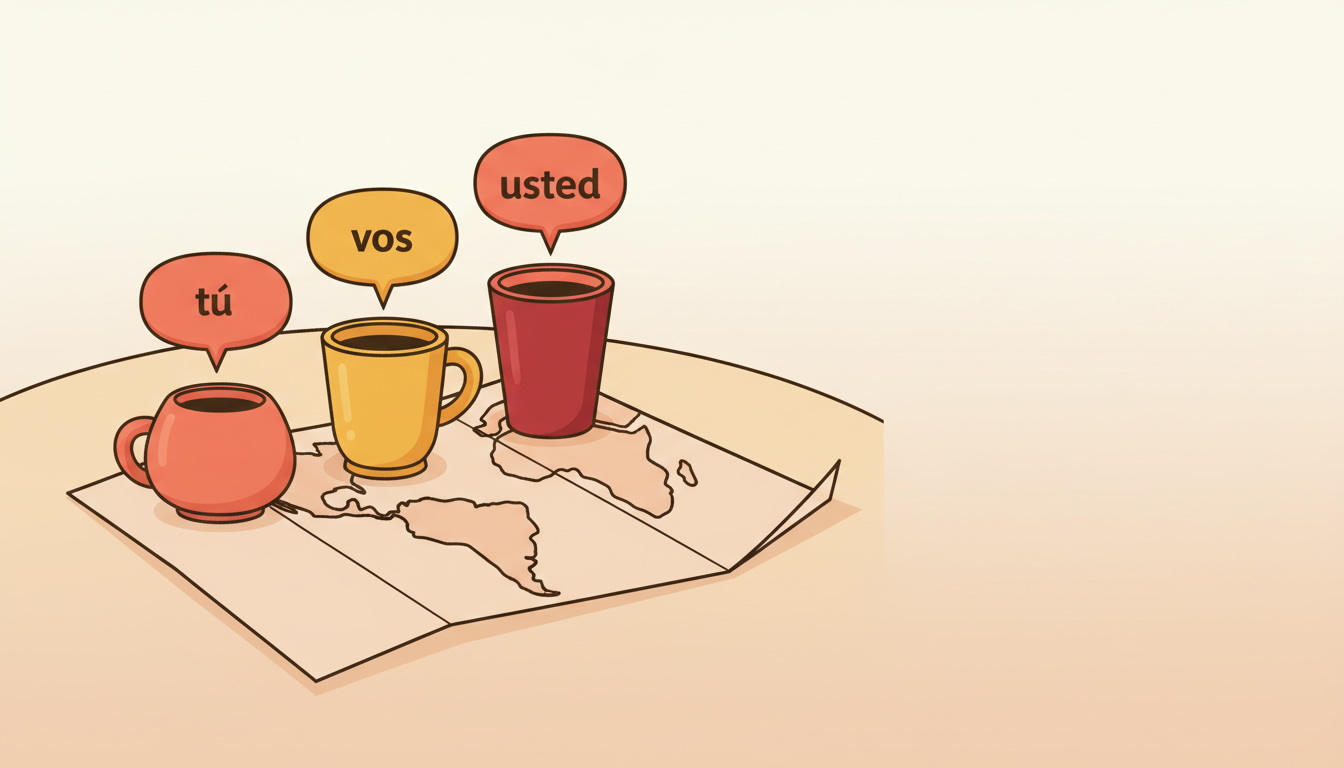
You land in Buenos Aires with two years of Spanish behind you, and the first sentence anyone aims at you is ¿De dónde sos? You know every word except the verb. Sos isn't in your conjugation table, and the pronoun it belongs to was a footnote somewhere around page 40.
The tú vs usted vs vos question has a geographic answer before it has a grammatical one. Here's which "you" your target country actually uses, the vos conjugations that take an evening to learn, and why usted in Bogotá means something close to the opposite of what your teacher told you.
The tú/usted switch is one system out of three
Tuteo is saying tú. Voseo is saying vos. Ustedeo is saying usted to your own mother, your best friend, and your dog. Textbooks teach the first and present usted as its formal setting. That model describes Mexico and Spain well. It falls apart in Buenos Aires, San Salvador, and Medellín.
Start with the scale. Linguists have counted the voseantes: the first voseo census (Morgan et al., 2017) put them at roughly a third of all Spanish speakers, a figure repeated in current research on teaching voseo to learners. This is not one country's slang.
The map tracks colonial trade routes rather than modern borders. Lima was a viceregal capital in constant contact with Spain, so Peru followed Spain into tú. The Río de la Plata sat at the far end of the supply chain and kept the older vos.
Where vos lives, it carries no stigma. The Academia Argentina de Letras accepted voseo as standard educated usage in 1982, and in Argentina it's accepted across every register, writing and schooling included (Instituto Cervantes).
Voseo conjugation: the vos verb forms are easier than tú's
Tú tienes becomes vos tenés. The pronoun changed, and so did the verb, which is the part most guides skip past in half a sentence.
Drop the -r, add -s, stress the ending, and the stem change disappears.
The rule fits on one line: take the infinitive, drop the -r, add -s, and put the stress on that final syllable. Endings come out as -ás, -és, -ís.
| Infinitive | tú | vos | usted |
|---|---|---|---|
| hablar | hablas | hablás | habla |
| comer | comes | comés | come |
| vivir | vives | vivís | vive |
| tener | tienes | tenés | tiene |
| poder | puedes | podés | puede |
| querer | quieres | querés | quiere |
| decir | dices | decís | dice |
| venir | vienes | venís | viene |
Look at the bottom half of that table. Because the stress moves onto the ending, the stem-changing verbs stop changing their stems. Puedes flattens to podés. Quieres flattens to querés.
The forms are easy. Producing them under pressure, halfway through a sentence you already started in tú, is not, and closing that gap takes a few weeks of talking.
The one irregular you need is ser, which gives you sos. Vos sos argentino. ¿Vos sos el hermano de Ana? You'll hear it within a minute of landing. It behaves like any other ser form. It just looks unfamiliar.
The imperative is where vos gets easy
Ven, ten, pon, di, sal, haz. Those six tú commands are irregular, they look nothing like their infinitives, and learners get them wrong for years. The vos versions are vení, tené, poné, decí, salí, hacé: infinitive minus the -r, stress on the end. That's the whole rule. One verb breaks it, and ir gives you andá.
Vení para acá. Hablá más fuerte, por favor. If you've been dreading Spanish commands, this is the one place where switching to vos gives you time back.
Two things change, and the rest of the pronoun set stays put
A vos te lo digo. The te is the same te you already know, and the possessive stays tu and tuyo. Only two things move: after a preposition you say para vos rather than para ti, and with con you say con vos. Say contigo in Buenos Aires and you'll sound like you learned Spanish in Madrid.
Only the forms after a preposition move; te, tu and tuyo stay exactly as you learned them.
The subjunctive is the one real complication
In Buenos Aires, "don't worry" is No te preocupes. In San Salvador, Guatemala City, and Managua, it's No te preocupés. The Río de la Plata leans on the tuteo forms of the subjunctive while Central America uses voseo forms. Both are correct at home, and this is the one place where "learn vos" doesn't have a single answer.
Ustedeo: in Bogotá and San José, usted is how you talk to people you love
Picture a Costa Rican mother asking her four-year-old ¿Ya se lavó las manos? That's usted. To a toddler. She is not being cold with her own child. Usted is simply what you say to someone in Costa Rica.
This is documented. Schmidt-Rinehart and LeLoup interviewed 132 Costa Ricans across all seven provinces, asking how they address family, strangers, and pets. Their finding: "Ustedeo was overwhelmingly the form of choice in all contexts, voseo was noticeably present, and tuteo rarely appeared in the speech of the interlocutors." Between 71 and 100 percent said they address their own parents as usted. More than half use it with their dogs.
The interview quotes land harder than the percentages. "Ud. is for ticos." "I usually use Ud. with my mom, but if I use vos, it offends her." And on tú, repeatedly: "tú isn't Costa Rican." Meanwhile vos is declining among Costa Rican adults under thirty, which is why the guides that file Costa Rica next to Argentina have it backwards.
Colombia does the same thing in its capital. Bogotá's Rolo dialect is an area of strong ustedeo, the familiar use of usted, and Santander uses it in formal and informal registers alike. What that sounds like: spouses in Bogotá saying Amor, ¿usted me trae un tinto? Friends opening with ¿Usted qué hizo el fin de semana? Someone scolding a dog with ¡Venga acá! Quédese quieto. Ask which city, not which country.
For a learner this inverts the textbook instinct. You were trained to think usted creates distance and tú closes it. In Bogotá and San José, reaching for tú to be friendly is the marked move. In Costa Rica it can read as affected or simply foreign; in Bogotá it reads as less local, though it's gaining ground with younger speakers. The safe default in both cities is still the pronoun you were taught to save for the police. (In tuteo countries the old advice still holds. Usted to a friend in Madrid or Mexico City can land as mock-formality.)
In Cundinamarca and Boyacá you'll also hear sumercé, from su merced: deferential and affectionate at once. Recognize it, don't produce it.
Try it in Conversa
Practice with AI characters who adapt to your level and give real-time feedback.
Try Conversa FreeThe map: which countries use vos, tú, and usted
Argentina says vos, Peru says tú, and Costa Rica says usted to the dog. Here's the whole map.
| Country | Default form | What else you'll hear |
|---|---|---|
| Argentina | vos | tú effectively absent |
| Uruguay | vos | the hybrid tú tenés is common |
| Paraguay | vos | tú uncommon |
| Guatemala | vos | tú as a middle register, usted formal |
| Honduras | vos | usted between spouses and between friends |
| El Salvador | vos | tú barely used |
| Nicaragua | vos | vos across all social classes; tú mostly written |
| Costa Rica | usted | vos present but declining; tú rare |
| Colombia | mixed | usted in Bogotá, vos in Medellín, tú on the coast |
| Chile | mixed | tú as the pronoun with vos endings: tú tenís |
| Venezuela | tú | vos in Zulia; usted in the Andes |
| Bolivia | mixed | vos in Santa Cruz and Tarija; the highlands pair tú with vos verb forms |
| Ecuador | mixed | tú and usted nationally; vos in the Sierra |
| Mexico | tú | vos survives in rural Chiapas |
| Peru | tú | vos in some Andean areas, fading |
| Cuba | tú | vos only in Camagüey |
| Dominican Rep. & Puerto Rico | tú | no voseo |
| Panama | mixed | tú and usted; vos only near the Costa Rican border |
| Spain | tú | vosotros for the informal plural |
Row sources: Wikipedia's voseo article and Central American Spanish. Panama is the one Central American country with no voseo, which surprises people who lump it in with its neighbors.
Chile conjugates vos but says tú
Chileans attach vos verb endings to the pronoun tú: tú tenís, tú hablái, tú podís. The endings run -ái and -ís rather than the -ás/-és/-ís above, because Chilean voseo descends from a different historical paradigm. Saying vos out loud as the pronoun is marked there and can come across as coarse. The famous tag ¿cachái? ("get it?") is exactly this form, the vos conjugation of cachar, glued onto the end of half the sentences in Santiago.
The same coffee invitation, three ways
Mexico City
— ¿Quieres ir por un café? — Va, ¿a qué hora puedes? — ¿Te late a las cinco? — Sale, ahí te veo.
Buenos Aires
— ¿Querés ir a tomar un café? — Dale, ¿a qué hora podés? — ¿Te viene bien a las cinco? — Buenísimo, che. Nos vemos allá.
Bogotá
— ¿Quiere ir por un tinto? — Claro, ¿a qué horas puede? — ¿Le sirve a las cinco? — Listo, parce, nos vemos allá.
Now count what actually moved. The verb ending: quieres / querés / quiere. One clitic: te / te / le. The sentence skeleton is identical in all three cities. One substitution, applied consistently, and you have all three.
The verb ending moves: quieres / querés / quiere. The skeleton of the sentence stays put.
The rest is vocabulary, and it's the fun kind. Tinto in Colombia is a small black coffee, never red wine. Dale and che are Argentine, parce is Colombian, and they belong to the same regional splits that give away a Spanish speaker's origin in about four words.
Vosotros: learn to recognize it, don't drill it
¿Vosotros habláis español? is a sentence you'll hear in Spain and essentially nowhere else. Latin America uses ustedes for the formal and informal plural alike, so one form covers what Spain splits into two.
Even inside Spain there's a wrinkle. In the Canary Islands and parts of western Andalusia, vosotros survives only in formal oratory, and ustedes covers both registers exactly as it does in Bogotá.
If you're heading anywhere in the Americas, treat vosotros as a listening skill. Recognize habláis in a subtitle without stopping the show, and skip the conjugation drills.
Pick one system and drop the rest
If your ticket says Buenos Aires, learn vos and never conjugate tú again. Country first, pronoun second. Most textbooks do this backwards. They hand you four paradigms and let you sort out the geography later. That's how learners end up half-fluent in a register nobody around them uses.
Argentina, Uruguay, Paraguay, or Central America minus Panama: learn the vos present and the vos imperative, once your tú present is solid enough that you can hear the difference. Colombia or Costa Rica: default to usted and stop treating it as stiff. Mexico, Peru, the Caribbean, Spain: the tú you already have is the right tool.
What no chart gives you is the switch itself, the moment you have to decide mid-sentence which form this particular person expects. That takes reps out loud with someone who will flinch at the wrong form, which is what an AI conversation partner like Conversa is for.
One caveat before you commit: these systems are moving, and they aren't all moving the same way. Spain and much of Colombia are drifting toward tú in situations that once demanded usted, while Costa Rican researchers found younger speakers using usted more, not less.
None of which matters at passport control. Someone in Buenos Aires is going to ask ¿De dónde sos? within your first hour, and the goal isn't to parse the verb. It's to answer before you've finished noticing it wasn't in the textbook.