Tell your English teacher "I'm so annoiato in this class" and you think you've said you're bored. What lands is "I'm so annoyed" — you've just told them the class irritates you. The word you wanted was bored. English annoyed is infastidito, a different feeling entirely, and now your teacher thinks you're angry when you were only sleepy.
That is the whole problem with Italian-English false friends in one sentence. The two languages share thousands of Latin-rooted words, so an Italian speaker reaches for a cognate with total confidence. Most of the time it works. Importante is important, possibile is possible, animale is animal. The danger isn't the words that look strange. It's the ones that look 100% familiar and have quietly drifted a few degrees off, because nobody stops to check a word that feels like an old friend.
These are the falsi amici, the false friends. Here are the ones that actually bite, grouped by where they ambush you, with the real English word for each.
Why the closest words are the most dangerous
Attualmente looks exactly like actually and means currently. You say "Actually I live in Rome" when you mean "Currently I live in Rome," and the sentence is grammatical, fluent, and wrong. No alarm goes off. That's the trap, and it's built into the shared vocabulary: Italian and English both pulled heavily from Latin, so a huge slice of the two lexicons overlaps, your brain learns to trust the overlap, and the trust is mostly rewarded. Which is exactly why false friends survive into advanced speech. They don't feel like mistakes. French speakers walk into the same wall with their own faux amis; the Italian list just has its own cast of characters.
At the hotel and on the move
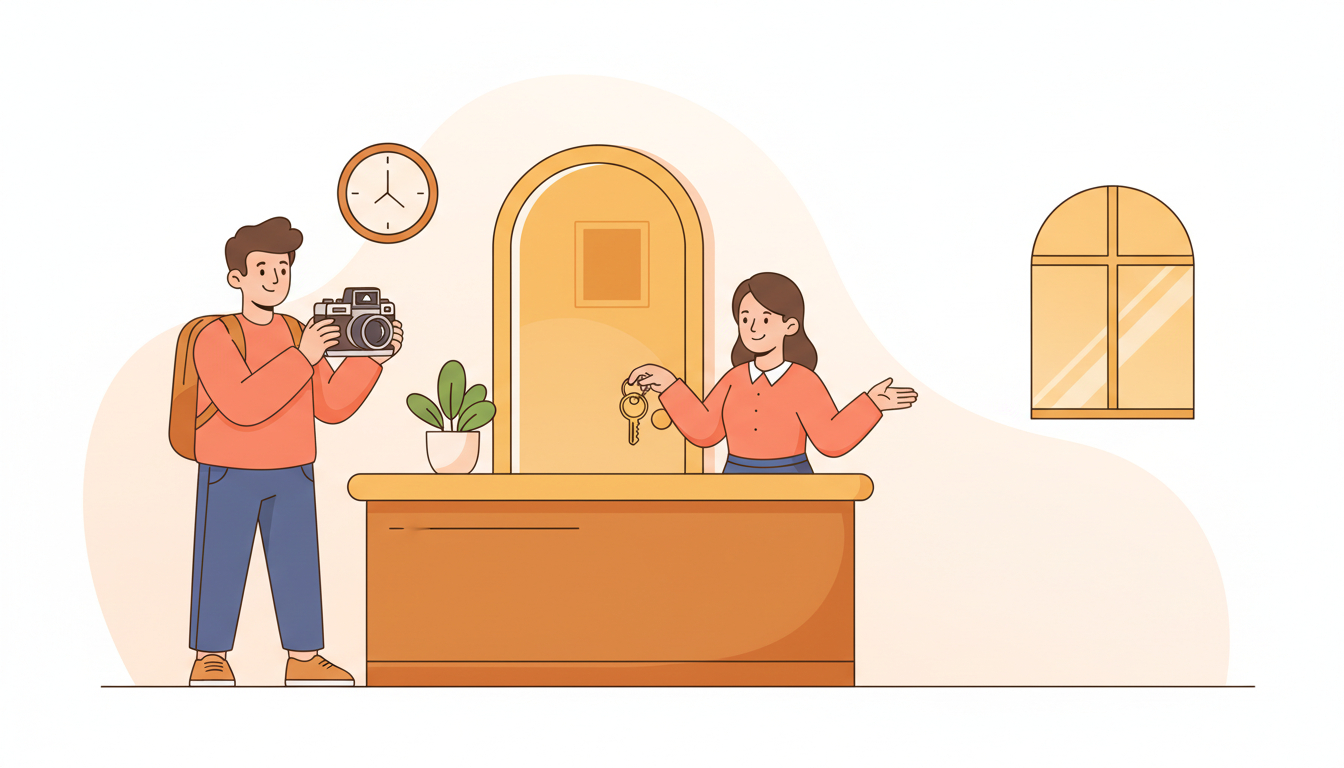
You're booking a room in London and you ask for "a camera for two nights." The receptionist pictures a photographic device. In Italian camera is a room: camera doppia is a double room, camera singola a single. The English camera, the thing you take photos with, is macchina fotografica. Ask for "a double room," not a camera.
Then you miss your train and tell someone "I lost the coincidence." Coincidenza does mean coincidence, but it carries a second sense English doesn't: a transport connection, the connecting train or flight (WordReference). "I missed my connection" is the sentence. This one is only a partial false friend, which makes it sneakier: half the time it's fine, and that lulls you.
And when you talk about the season, estate is summer, not a property or an estate. "In estate fa caldo" is "In summer it's hot." An English "estate" is a proprietà or tenuta.
At the office
Say "the client pretends too much from us" in a meeting and your colleague hears something strange. Pretendere looks like pretend and means the opposite of harmless: to demand or expect. "The client demands too much" is the sentence you wanted. To pretend, as in to fake, is fingere or far finta.
These office traps cost you credibility because they show up in the moments you most want to sound competent. Attualmente is currently, not actually (TJ Taylor): "Attualmente lavoro da casa" is "I currently work from home," and the English actually is in realtà or veramente. Argomento is the topic or subject, not an argument, so "the argument of the meeting was the budget" should be "the topic of the meeting"; an argument in the quarrel sense is a discussione or litigio.
Two verbs finish the office set. Confrontare is to compare, not to confront. "Confronta i due prezzi" is "compare the two prices," while to confront someone is affrontare. And assistere a is to attend or witness, not to assist: "ho assistito alla riunione" means "I attended the meeting," not that you helped run it. To assist is aiutare.
With family and friends
Parenti is relatives, not parents, and this is where the mistakes get personal. "I'm visiting my parenti" means your aunts, cousins, and grandparents, not your mother and father. Your parents, specifically, are your genitori. Wikipedia lists this exact pair as a classic false friend (Wikipedia).
Nipote is the honest one, because it genuinely won't sit still. It means grandchild and also niece or nephew, and only context tells you which (WordReference). "Mia nipote ha cinque anni" could be my granddaughter or my niece. When you switch to English you have to pick the exact word Italian let you leave vague.
Two adjectives round out the social traps. Simpatico is nice or likeable, not sympathetic. "My colleague is very simpatico" means she's fun to be around; if you mean she's understanding when you're upset, that's comprensivo. And educato is polite or well-mannered, not educated. Calling a child educato praises their manners, not their schooling. Educated, as in well-schooled, is istruito or colto.
The everyday words that quietly flip
Back to annoiato from the top: bored, not annoyed. It's worth repeating because it's high-frequency and the feelings it confuses are almost opposites. Bored is annoiato; annoyed is infastidito or seccato.
Sensibile is sensitive, not sensible. "He's a very sensibile person" means he feels things deeply, not that he's practical. Sensible, meaning reasonable, is sensato or ragionevole.
Libreria is a bookshop (and also a bookcase), not a library. You buy a book in libreria; you borrow one from a biblioteca. So "I returned the book to the libreria" is the wrong building.
Then a pair that cross-wires in both directions: fattoria is a farm, and fabbrica is a factory. Neither is what it looks like. Fattoria isn't a factory, and fabbrica isn't fabric (fabric, the cloth, is tessuto or stoffa). If you say "my uncle works in a fattoria" you've put him on a farm; "in a fabbrica" puts him in a factory. Keep them straight and you avoid two mistakes with one pair.
Last in this set: eventualmente is possibly or if-need-be, not eventually. "Eventualmente possiamo incontrarci" is "We could possibly meet," not "We'll eventually meet." Eventually, meaning in the end, is alla fine or prima o poi.
Try it in Conversa
Practice with AI characters who adapt to your level and give real-time feedback.
Try Conversa FreeThe partial false friends nobody warns you about
Realizzare used to mean strictly to accomplish or carry out: "ha realizzato il suo sogno," she achieved her dream. But modern Italian has borrowed the English sense too, and now realizzare also means to realize, to become aware (WordReference). It's no longer a clean false friend, it's a word doing two jobs. That's the messy truth most lists skip: a few of these have drifted far enough that the honest answer is "it depends." Don't over-correct yourself out of the "realize" meaning; both are live now.
Coincidenza and nipote from earlier belong here too. They aren't wrong-vs-right, they're words that carry an extra sense English splits into two. The skill isn't memorizing a forbidden word, it's noticing when the Italian is doing more than the English cognate can.
The two-column trust check
Take 20 of these lookalikes and make two columns: the Italian meaning on the left, the true English meaning on the right. Camera: room / not camera. Attualmente: currently / not actually. Parenti: relatives / not parents. The rows where the two columns disagree are your flashcard deck. The rows where they match, you can throw away. Reading a list once doesn't build the reflex; building the deck yourself does.
Then review the deck by scenario, not alphabetically. You want camera to surface when you're booking a hotel and attualmente to surface in a status meeting, because that's where the mistake actually happens. A word learned in the situation it belongs to comes back in that situation. A word learned in an A–Z list stays in the list.
The fastest way to burn these in is to catch yourself using one wrong out loud and fix it, which is what conversation practice with a patient partner gives you that a list can't. Conversa is an AI conversation partner you can talk to for exactly this: you practice the situations these words live in, so when "I assisted the meeting" slips out for assistere, you get the right word, attended, in context instead of on a flashcard.
The real goal
Start with the five that bite hardest: attualmente, annoiato, parenti, pretendere, libreria. You're not memorizing a list of forbidden words, you're building one small instinct: pause on the words that look too familiar. The strangest-looking English word is safe, because you'll look it up. The one that looks exactly like Italian is the one that betrays you, precisely because you won't. Once those five feel suspicious on sight, the rest will start to give themselves away. And when vocabulary stops tripping you, the next Italian-speaker snag is usually grammar, like when to use the English simple past.