The waiter asked what I wanted, and I told him, in confident German, that I would become a schnitzel. Ich werde ein Schnitzel. He didn't blink, because waiters in Berlin have heard everything, but the word I wanted was bekommen, "to receive," not werden, "to become." I'd reached for the English-looking word and it turned on me. That is the whole problem with German false friends: German shares so much vocabulary with English that you let your guard down, and then a word you were sure about means something you never intended.
The good news is that these misfires aren't random. They cluster in the same handful of situations for every English speaker: the office, the restaurant, the shop, the doctor's office. Learn them grouped by the scene where they ambush you, with the word you actually wanted sitting right next to the trap, and they stick far better than a 200-word alphabetical list ever will.
Why German false friends look English but still lie to you
Kollege looks like a trap and isn't one: it means colleague or coworker, exactly what you'd guess. Start there, because German paranoia is its own problem. Most German-English cognates behave like Kollege. Haus is house, Wasser is water, Finger is finger. The two languages are close cousins, and the overlap is real.
The trouble is the small set of words that drifted. A word entered German centuries ago, kept an older meaning, or narrowed to one specific sense, while its English twin wandered off somewhere else. You can't predict which words did this. But you can predict where you'll meet them. So here they are, by scene.
At the office: Chef, Rente, Aktion
Call your boss Chef and you're right, even though your ear is screaming that you just called her a cook. Chef means boss or manager, not a professional cook. The cook is der Koch, and the head chef of a kitchen is der Küchenchef. Your female boss is die Chefin. Mein Chef hat das Meeting abgesagt means "my boss cancelled the meeting."
Rente is the one that costs you money if you mishear it. It means pension, the income you get after you retire, not rent. Rent to a landlord is die Miete. Notice the double trap in this one: Mein Großvater bekommt eine kleine Rente means "my grandfather gets a small pension," with bekommt doing its real job of "receives." Two false friends in five words.
Aktion shows up on shop signs and in work emails, and it almost never means "action" in the movie sense. It means a promotion, a sale, a campaign. Diese Woche läuft eine Aktion means "there's a promotion running this week." The action of an action film is die Handlung, the plot.
At the restaurant: bekommen and the set-meal Menü
Order by saying Ich bekomme ein Schnitzel and you'll sound like a local, not like someone announcing a transformation. bekommen means to receive or get, and using it to order food is completely normal: Ich bekomme die Suppe, bitte, "I'll have the soup, please." You can also say Ich hätte gern or Ich nehme; none of them is the one "correct" form. The word that ambushed me at the top of this post, werden, is the real "to become." Es wird kalt means "it's getting cold." Keep the two apart and you'll never accidentally offer yourself up as the main course.
Menü is the other restaurant trap, and it's sneaky because it lands so close. A Menü is a fixed set meal: starter, main, dessert, or the combo of the day. It is not the list of dishes you're handed at the door. That's die Speisekarte, or just die Karte. Ich nehme das Menü 2 means "I'll take set meal number two." If you want to see what's on offer, ask for die Speisekarte.
At the shop: Gift, Handy, also, aktuell
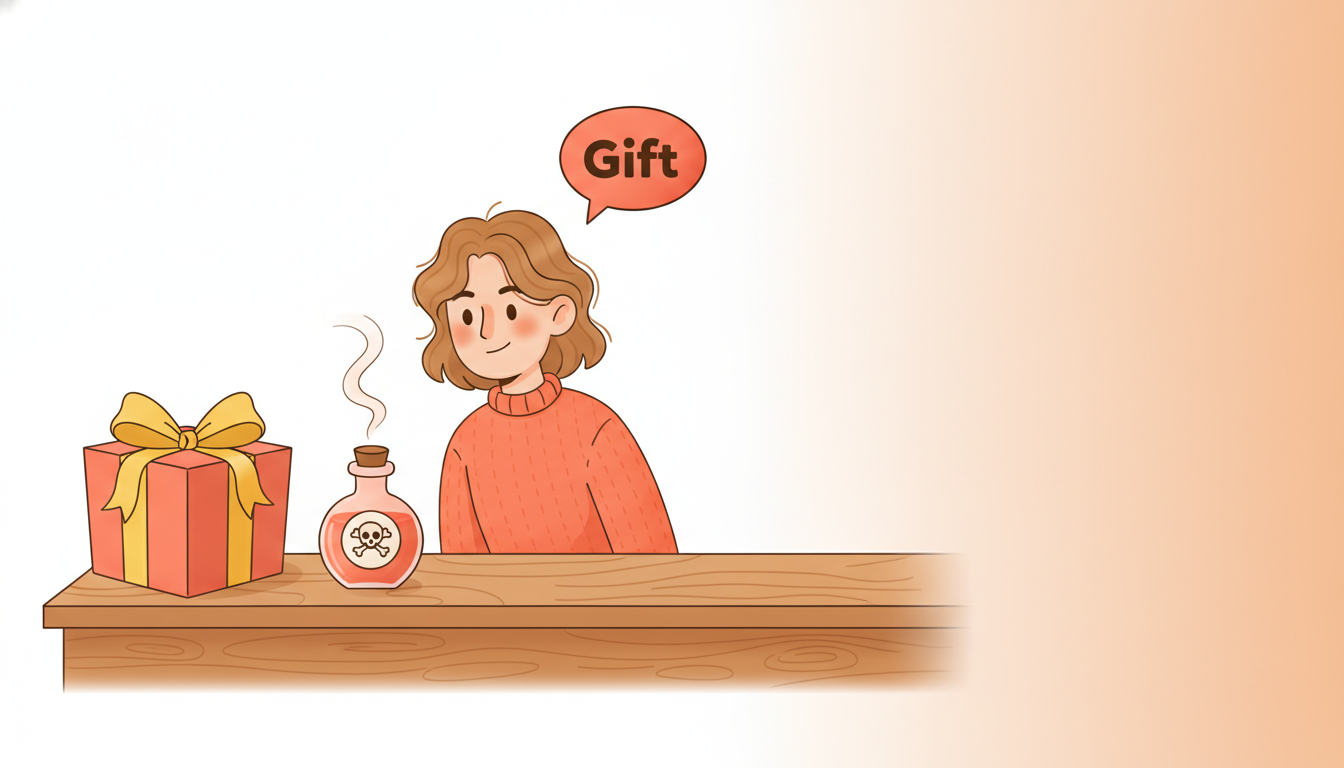
Ask a German shopkeeper to help you find ein Gift for your friend and you've just gone looking for poison. Gift means poison. A present is das Geschenk. The story goes that Gift and English "gift" share an old Germanic root tied to "giving", with the German sense sliding toward a "dose" and then toward poison, but treat that as a fun origin tale, not a rule. What you actually need is simpler: Vorsicht, das ist Gift means "careful, that's poison," and the birthday present is ein Geschenk.
A few more you'll hit on any afternoon out:
- Handy is a mobile phone, not the adjective "handy." Mein Handy ist fast leer means "my phone is almost dead." Convenient is praktisch.
- also means "so" or "therefore," and it opens sentences constantly: Also, fangen wir an, "so, let's begin." The English "also," meaning "too," is auch.
- aktuell means current or up-to-date, not "actually." Die aktuelle Version is "the current version." Actually, in the "in fact" sense, is eigentlich or tatsächlich.
- bald means soon. Wir sehen uns bald, "see you soon." It has nothing to do with hair, which catches more people than you'd expect: bald in the hairless sense is kahl, and a bald head is eine Glatze.
At the doctor: sensibel, Rezept, eventuell
Tell a German doctor you're feeling sensibel and you've said you're sensitive, not that you're being sensible. sensibel means sensitive, physically or emotionally. Sie ist ein sehr sensibler Mensch, "she's a very sensitive person." Sensible, in the reasonable sense, is vernünftig.
Rezept is a word you'll hear at both the doctor and the pharmacy, and it does double duty: it means prescription and also recipe. Context decides. Der Arzt hat mir ein Rezept gegeben is "the doctor gave me a prescription." The same word on a cooking blog is a recipe for apple cake.
eventuell is the one that can actually scramble your calendar. It does not mean "eventually." It means possibly, perhaps, maybe. Eventuell komme ich später means "I might come later," which is a very different message from "I'll eventually come later." If you mean eventually, in the "in the end" sense, that's schließlich. And while you're in the neighborhood: blamieren means to embarrass, not to blame. Ich habe mich total blamiert, "I totally embarrassed myself." To blame someone is beschuldigen.
Try it in Conversa
Practice with AI characters who adapt to your level and give real-time feedback.
Try Conversa FreeThe drill that actually makes them stick
Ich bekomme ein Schnitzel, aber ich werde nicht satt ("I'll get a schnitzel, but I won't get full"). One sentence that sets a false friend next to its correct twin does more than rereading a word-list fifty times, because the contrast is what wires the meaning in. Reading twenty pairs in a column feels productive and teaches you almost nothing: the pair sits quietly in your head until you're at a pharmacy counter, and then it evaporates.
So build the sentence yourself. Pick three false friends from a scene you'll actually be in this month. Eating out a lot? Take bekommen, werden, Menü. Starting a job in German? Take Chef, Rente, Aktion. Write one German sentence for each that uses the false friend and its correct replacement together. Saying it out loud beats rereading it, and practicing it as a real back-and-forth beats saying it alone, which is the kind of repetition an AI conversation partner like Conversa is built for: you can run the same restaurant or doctor's-office scene until the right word is the one that arrives first.
Half of these traps are nouns, so learning each article with its noun from the start (das Gift, das Geschenk, die Miete) heads off a second ambush. And if you like the words your textbook skipped, the little flavoring particles Germans drop into every sentence are the next thing worth stealing.
The next German word that looks suspiciously like English is guilty until proven innocent. Look it up, write the contrast sentence, say it once at a counter in your head. Gift means poison. You only need to get ambushed by that one once.